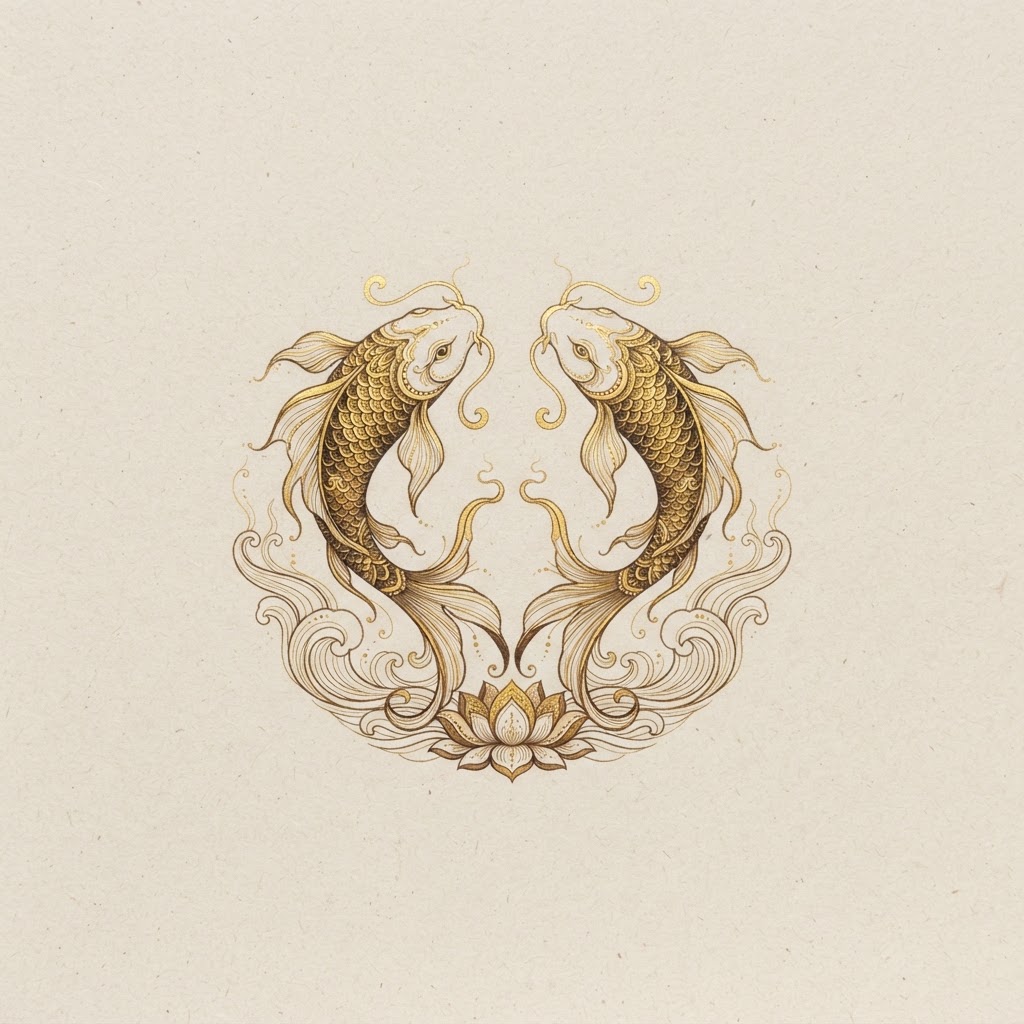
Golden Fishes: Meaning, Origin & Symbolism
Also known as: Matsyayugma, Two Golden Fish, Gaurmatsya
Buddhist
Buddhist
Sacral Chakra
Heart Chakra
Water
Freedom
Harmony
Joy
Abundance
A pair of graceful leaping fish symbolizing spiritual freedom, fearlessness, and effortless navigation through the ocean of suffering.
Quick Facts
- Category
- Buddhist
- Culture / Origin
- Buddhist
- Geographic Origin
- Ancient India
- Historical Period
- Iron Age
- Estimated Age
- circa 6th century BCE
- Element
- Water
- Planet
- Venus
- Chakra
- Sacral, Heart
- Zodiac
- Pisces
- Verification
- unverified
What is Golden Fishes?
The Two Golden Fishes (Matsyayugma in Sanskrit, Sergyi Nya in Tibetan) form an essential component of the Ashtamangala, the Eight Auspicious Symbols of Buddhism. Usually depicted as two carp or freshwater river fish positioned vertically with their heads turned toward one another, the symbol exudes grace, fluidity, and mutual harmony.
Fish live completely submerged in water yet remain unhindered by its weight, swimming freely across vast expanses without fear of drowning. In Buddhist metaphor, sentient beings are immersed in Samsara—the turbulent ocean of worldly suffering. The two golden fishes thus signify the awakened being who navigates the waters of existence without drowning in distress, living in absolute spiritual liberation and boundless joy.
Meaning of Golden Fishes
The Golden Fishes represent liberation, fearlessness, and spiritual fertility, moving freely through worldly existence without drowning in suffering.
Origin & History
In ancient pre-Buddhist India, two fish represented the sacred rivers Ganges and Yamuna, carrying connotations of fertility, life-giving abundance, and purification. Within Buddhist iconology, this geography was transmuted into an inward map: the fish came to symbolize the main subtle energy channels (Ida and Pingala / Lalana and Rasana) converging into spiritual balance.
Spiritual Meaning
The symbol signifies fearlessness (Abhaya) in the face of life's unpredictable currents. For the practitioner, it represents the ability to remain buoyant, serene, and spiritually joyful regardless of external conditions.
Symbolism
The fish's open eyes symbolize the watchful awareness of the Buddha, as fish do not close their eyes. Their pairing represents harmony, happiness, and the balance of energy channels.
Traditional Uses
Historically understood as an omen of happiness, good fortune, and fertility, while also serving as a metaphor for the practitioner's ultimate triumph over samsaric drowning.
Modern Spiritual Uses
Modern spiritual adherents interpret the twin fishes as symbols of harmonious relationships, emotional agility, and navigating stressful life transitions with poise.
Healing Associations
Soothes nervous tension, balances energetic polarities, and fosters emotional adaptability.
Protection Associations
Protects against emotional overwhelm, anxiety in chaotic situations, and fear of change.
How the Symbol Is Used
- •Pranayama (breath balancing)
- •Tibetan ritual art
- •Auspicious wedding blessings
- •Meditation on non-attachment
Cultural Context
Buddhist — Ancient India (Iron Age)
Sources & References
- 1.The Handbook of Tibetan Buddhist Symbols by Robert Beer
- 2.Buddhist Symbols in Tibetan Culture by Dagyab Rinpoche
- 3.Tibetan Art by Lokesh Chandra
This content is for educational and informational purposes only. Where modern spiritual interpretations are described, they are not presented as ancient historical facts. It is not a substitute for professional medical or spiritual advice.