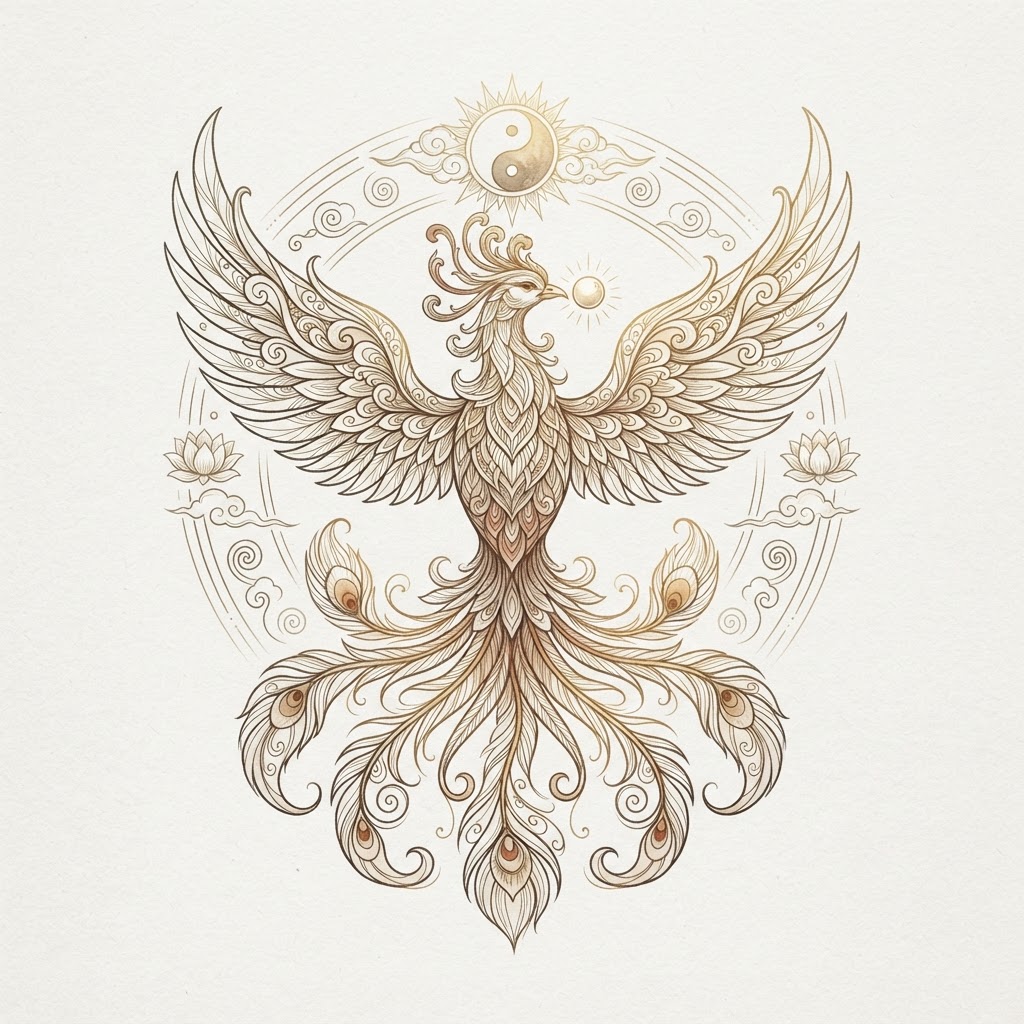
Fenghuang: Meaning, Origin & Symbolism
Also known as: Chinese Phoenix, Vermilion Bird, Bird of Immortality
Taoist/Chinese
Taoist/Chinese
Heart Chakra
Crown Chakra
Fire
Love
Harmony
Grace
Transformation
The celestial queen of birds representing supreme Yin grace, virtue, harmonious peace, and imperial matriarchy.
Quick Facts
- Category
- Taoist/Chinese
- Culture / Origin
- Taoist/Chinese
- Geographic Origin
- China
- Historical Period
- Shang Dynasty to present
- Estimated Age
- 3000+ years
- Element
- Fire
- Planet
- Venus
- Chakra
- Heart, Crown
- Deities
- Queen Mother of the West (Xiwangmu), Guanyin
- Verification
- unverified
What is Fenghuang?
The Fenghuang, commonly translated as the Chinese Phoenix, is a magnificent mythical bird that presides over all feathered creatures in Chinese cosmology. Originally distinguished as a pair of birds—'Feng' representing the male solar bird and 'Huang' representing the female lunar bird—the two identities gradually coalesced into a single unified feminine archetype representing supreme Yin elegance, peace, and moral excellence.
In classical literature, the Fenghuang is described as having the beak of a rooster, the jaw of a swallow, the neck of a snake, the breast of a goose, the back of a tortoise, and the tail of a peacock. Uniquely benevolent, the Fenghuang harms neither living insects nor blades of grass, feeds only upon bamboo seeds, and nests exclusively upon the sacred Paulownia (Wutong) tree.
Throughout imperial Chinese history, the Fenghuang served as the official insignia of the Empress, perfectly balancing the masculine imperial Dragon of the Emperor. Together, the Dragon and Phoenix form the preeminent motif of marital bliss, union, and cosmic harmony.
Meaning of Fenghuang
The Fenghuang embodies refined virtue, grace, prosperity, peace, and the harmonious manifestation of the Yin principle.
Origin & History
Artifacts depicting mythical bird totems with long plumed tails date back to the Shang and Western Zhou dynasties. The Fenghuang was believed to appear solely during times of great social peace, righteousness, and benevolent imperial governance, making its reported sighting an auspicious sign of Heaven's approval.
During the Han Dynasty, the imagery of the Fenghuang became intertwined with the Vermilion Bird of the South (Zhuque), one of the Four Sacred Celestial Animals associated with summer and the fire element. Throughout the Ming and Qing dynasties, the Fenghuang adorned bridal robes, imperial tiaras, and palace walls across the empire.
Spiritual Meaning
Spiritually, the Fenghuang personifies the embodiment of moral integrity and refined, elevated consciousness. According to ancient Taoist lore, the physical body of the Fenghuang reflects the five cardinal Confucian-Taoist virtues: its head represents virtue (De), its wings represent righteousness (Yi), its back represents propriety (Li), its breast represents benevolence (Ren), and its belly represents trustworthiness (Xin).
Unlike the Western phoenix, which immolates itself in flames to be reborn, the Fenghuang represents peaceful, effortless presence, non-violence, and spiritual majesty. It appears when human affairs align with the harmonious order of Heaven and Earth, reminding seekers that spiritual attainment produces unmistakable peace, beauty, and quiet dignity.
Symbolism
Its five sacred colors (black, white, red, green, yellow) symbolize the complete harmony of the Five Elements (Wuxing). Its gentle demeanor represents harmlessness and moral purity, while its partnership with the dragon embodies the ideal alchemical balance of Yin and Yang.
Traditional Uses
Traditionally revered as an omen of enduring peace, prosperity, and cosmic favor. It is prominently featured in traditional weddings to bless unions with enduring harmony, fidelity, and royal grace.
Modern Spiritual Uses
In modern settings, the Fenghuang represents resilience, refined personal grace, feminine leadership, inner dignity, and the elevation of consciousness above chaotic circumstances.
Healing Associations
Associated with heart soothing, calming excessive anxiety, and restoring gentle emotional balance through its peaceful resonance.
Protection Associations
Placed in living spaces to dispel acrimony, ward off marital discord, and bring a serene, peaceful energetic atmosphere to the home.
How the Symbol Is Used
- •Feng Shui
- •Wedding Rituals
- •Imperial Ceremonies
- •Meditation on Five Virtues
Cultural Context
Taoist/Chinese — China (Shang Dynasty to present)
Sources & References
- 1.Eberhard, Wolfram. 'A Dictionary of Chinese Symbols' (1986)
- 2.Welch, Patricia Bjaaland. 'Chinese Art: A Guide to Motifs and Images' (2008)
- 3.Allan, Sarah. 'The Shape of the Turtle: Myth, Art, and Cosmos in Early China' (1991)
This content is for educational and informational purposes only. Where modern spiritual interpretations are described, they are not presented as ancient historical facts. It is not a substitute for professional medical or spiritual advice.