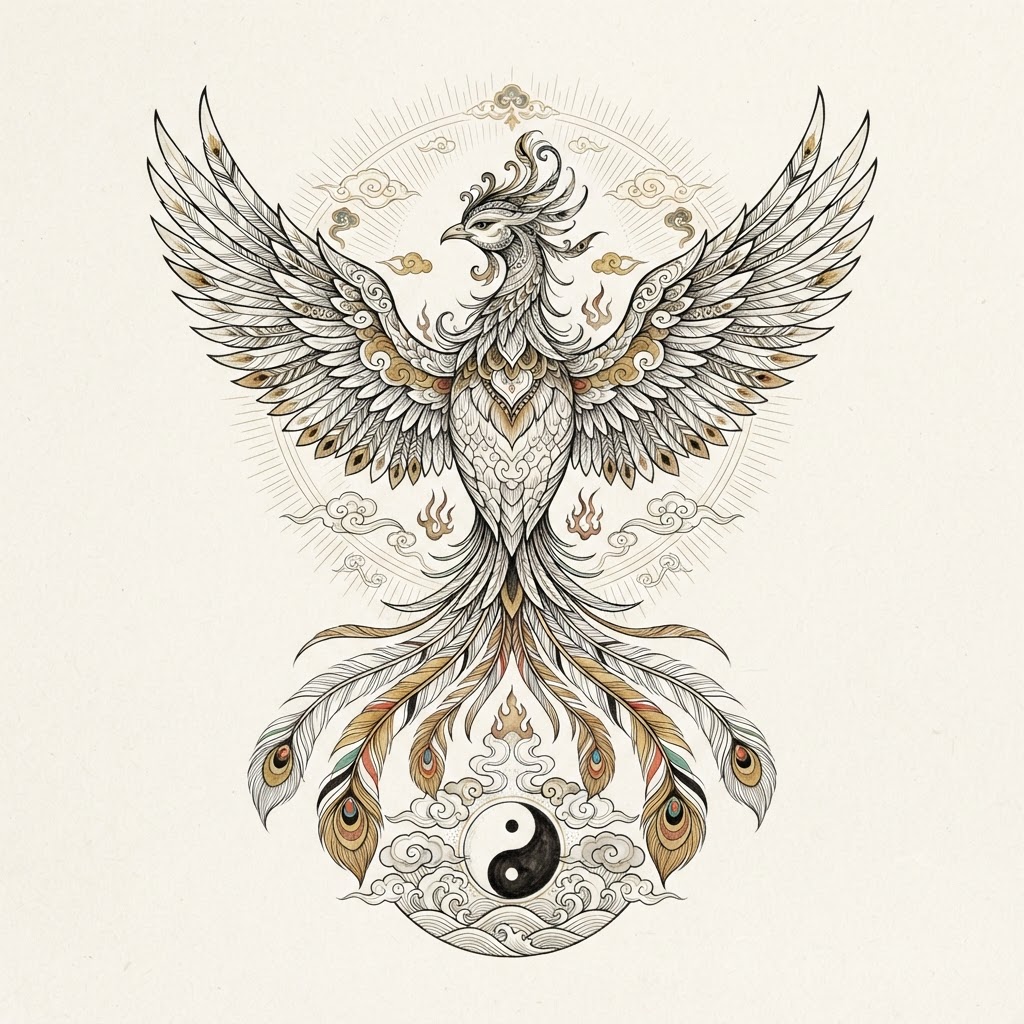
Fenghuang (Chinese Phoenix): Meaning, Origin & Symbolism
Also known as: Chinese Phoenix, Vermilion Bird, Bird of Immortality
Taoist/Chinese
Taoist/Chinese
Heart Chakra
Crown Chakra
Fire
Harmony
Love
Peace
Transformation
The celestial queen of birds representing grace, virtuous conduct, high morality, and the harmonic balance of Yin.
Quick Facts
- Category
- Taoist/Chinese
- Culture / Origin
- Taoist/Chinese
- Geographic Origin
- China
- Historical Period
- Shang and Zhou Dynasties
- Estimated Age
- circa 3000 BCE
- Element
- Fire
- Planet
- Venus
- Chakra
- Heart, Crown
- Zodiac
- Rooster
- Deities
- Queen Mother of the West (Xiwangmu)
- Verification
- unverified
What is Fenghuang (Chinese Phoenix)?
The Fenghuang is an immortal mythical bird revered throughout Chinese and Taoist culture. Often translated into English as the 'Phoenix', the Fenghuang differs considerably from the Greek bird that burns and rises from its own ashes. Instead, the Fenghuang is the sovereign of all feathered beings, symbolizing eternal grace, supreme virtue, social harmony, and celestial order. Historically, 'Feng' designated the male bird and 'Huang' the female, embodying an internal duality that later unified into a singular symbol of the highest feminine power (Yin). Frequently depicted paired with the Dragon, the Fenghuang represents marital fidelity, peace, and cultural prosperity. In traditional iconography, its body parts correspond to cosmological virtues: its head represents virtue, its wings duty, its back propriety, its abdomen trust, and its breast benevolence.
Meaning of Fenghuang (Chinese Phoenix)
Radiant virtue, feminine majesty, peace, beauty, and auspicious national and domestic harmony.
Origin & History
Depictions of raptor-like sacred birds appear on Shang dynasty oracle bones and bronze ritual vessels. According to legendary chronicles, the Fenghuang appeared only in times of great peace, flourishing culture, and enlightened governance, disappearing whenever a ruler turned tyrannical. During the Ming and Qing dynasties, the Fenghuang became the primary symbol of the Empress, matching the Emperor's Dragon. In Taoist lore, immortals are frequently depicted riding through the clouds upon its radiant back.
Spiritual Meaning
The Fenghuang signifies spiritual refinement, purification, and the embodiment of living ethics. It encourages practitioners to cultivate quiet inner elegance, empathy, and righteous living, illustrating that true power arises through gentle integration and spiritual nobility.
Symbolism
Its colorful feathers incorporate the five sacred colors (black, white, red, green, yellow), which symbolize the Five Phases (Wuxing) and universal balance. Its sighting heralds universal harmony and divine favor.
Traditional Uses
Regarded as a divine messenger that descends to signal peace, virtuous dynastic rule, and the union of heaven and earth.
Modern Spiritual Uses
Seen as an inspirational totem of resilience, grace under pressure, unconditional self-worth, and sacred feminine leadership.
Healing Associations
Linked with heart-centering practices, soothing chaotic emotional states, and restoring gentle vitality to the cardiovascular system.
Protection Associations
Displayed in wedding settings and family spaces to protect marital bonds from discord and shield homes from bad luck.
How the Symbol Is Used
- •Feng Shui
- •Daoist Ritual Dance
- •Traditional Weddings
Cultural Context
Taoist/Chinese — China (Shang and Zhou Dynasties)
Sources & References
- 1.Allan, Sarah. The Shape of the Turtle: Myth, Art, and Cosmos in Early China. SUNY Press, 1991.
- 2.Eberhard, Wolfram. A Dictionary of Chinese Symbols. Routledge, 1986.
This content is for educational and informational purposes only. Where modern spiritual interpretations are described, they are not presented as ancient historical facts. It is not a substitute for professional medical or spiritual advice.