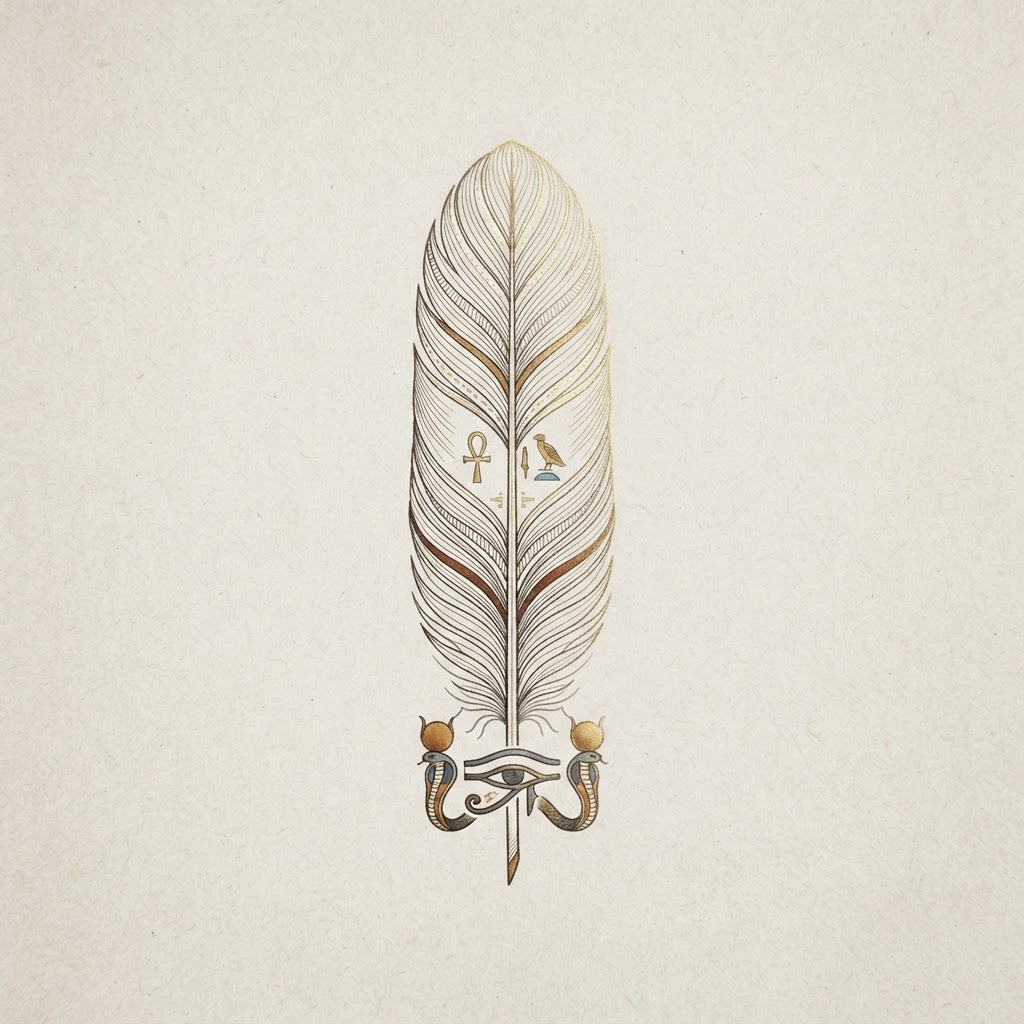
Feather of Ma'at: Meaning, Origin & Symbolism
Also known as: Ostrich Feather of Ma'at, Shu's Feather
Ancient Egyptian
Ancient Egyptian
Heart Chakra
Throat Chakra
Air
Wisdom
Love
Protection
The Feather of Ma'at is the sacred Egyptian emblem of cosmic truth, justice, balance, and divine moral order.
Quick Facts
- Category
- Ancient Egyptian
- Culture / Origin
- Ancient Egyptian
- Geographic Origin
- Nile River Valley, Egypt
- Historical Period
- Old Kingdom through Roman Period
- Estimated Age
- circa 2700 BCE
- Element
- Air
- Planet
- Venus
- Chakra
- Heart, Throat
- Zodiac
- Libra
- Deities
- Ma'at, Thoth, Anubis
- Verification
- unverified
What is Feather of Ma'at?
The Feather of Ma'at is a singular ostrich plume worn upon the head of the goddess Ma'at, who personified truth, cosmic balance, morality, and social order. In ancient Egyptian cosmology, Ma'at was the foundational fabric that kept the universe from collapsing back into primordial chaos (Nun).
The feather's most iconic appearance is in the judgment scene of the Book of the Dead, known as the Weighing of the Heart. Upon entering the Hall of Two Truths, the heart (Ib) of the deceased was placed on one side of a great golden scale, balanced against the pristine Feather of Ma'at on the other.
If the heart was light and unburdened by guilt, deceit, and wickedness, it balanced perfectly with the feather, granting the deceased entry into the paradise of Aaru (the Field of Reeds). If weighed down by transgression, the heart was devoured by the monstrous hybrid Ammit, leading to permanent spiritual annihilation.
Meaning of Feather of Ma'at
The primary meaning of the Feather of Ma'at is moral integrity, cosmic order, divine truth, and universal justice.
Origin & History
Egyptian judges and high priests were initiated into the service of Ma'at and frequently wore small golden feather pendants to mark their dedication to objective, incorruptible justice. Pharaohs took the title 'Beloved of Ma'at' and regularly presented an image of the goddess or her feather to the major deities as the supreme sacrificial offering.
By offering Ma'at, the Pharaoh signaled to the gods that they had successfully maintained divine law, fed the hungry, cared for the weak, and preserved harmony in the land of Egypt.
Spiritual Meaning
On a spiritual level, the Feather of Ma'at demands profound self-examination, radical honesty, and personal alignment with the laws of the universe. It serves as a reminder that deeds, thoughts, and intentions carry spiritual weight.
To have a heart 'as light as a feather' signifies the purification of past guilt, liberation from toxic attachments, and living a life rooted in genuine integrity.
Symbolism
The ostrich feather represents absolute symmetry, lightness, and truth, as ostrich feathers are extraordinarily uniform and even on both sides of the central shaft.
Traditional Uses
Regarded as the universal benchmark of divine law against which all mortal actions are measured during the judgment of the soul.
Modern Spiritual Uses
Modern seekers utilize the Feather of Ma'at as an inspiration for mindful ethical living, emotional decluttering, conflict resolution, and karmic balance.
Healing Associations
Assists in emotional heart healing, easing guilt, clearing shame, and calming chronic anxiety.
Protection Associations
Protects against moral decay, false accusations, corrupt systems, and spiritual damnation.
How the Symbol Is Used
- •Ethical reflection
- •Heart-lightening meditation
- •Karmic clearing
Cultural Context
Ancient Egyptian — Nile River Valley, Egypt (Old Kingdom through Roman Period)
Sources & References
- 1.Teeter, Emily. 'The Presentation of Maat: Ritual and Legitimacy in Ancient Egypt.' Oriental Institute of the University of Chicago, 1997.
- 2.Assmann, Jan. 'The Mind of Egypt: History and Meaning in the Time of the Pharaohs.' Metropolitan Books, 2002.
This content is for educational and informational purposes only. Where modern spiritual interpretations are described, they are not presented as ancient historical facts. It is not a substitute for professional medical or spiritual advice.