Fasces: Meaning, Origin & Symbolism
Also known as: Fasces lictoriae, Roman Bundle
Greek & Roman
Etruscan & Roman
Solar Plexus Chakra
Root Chakra
Fire
Strength
Protection
Order
Discernment
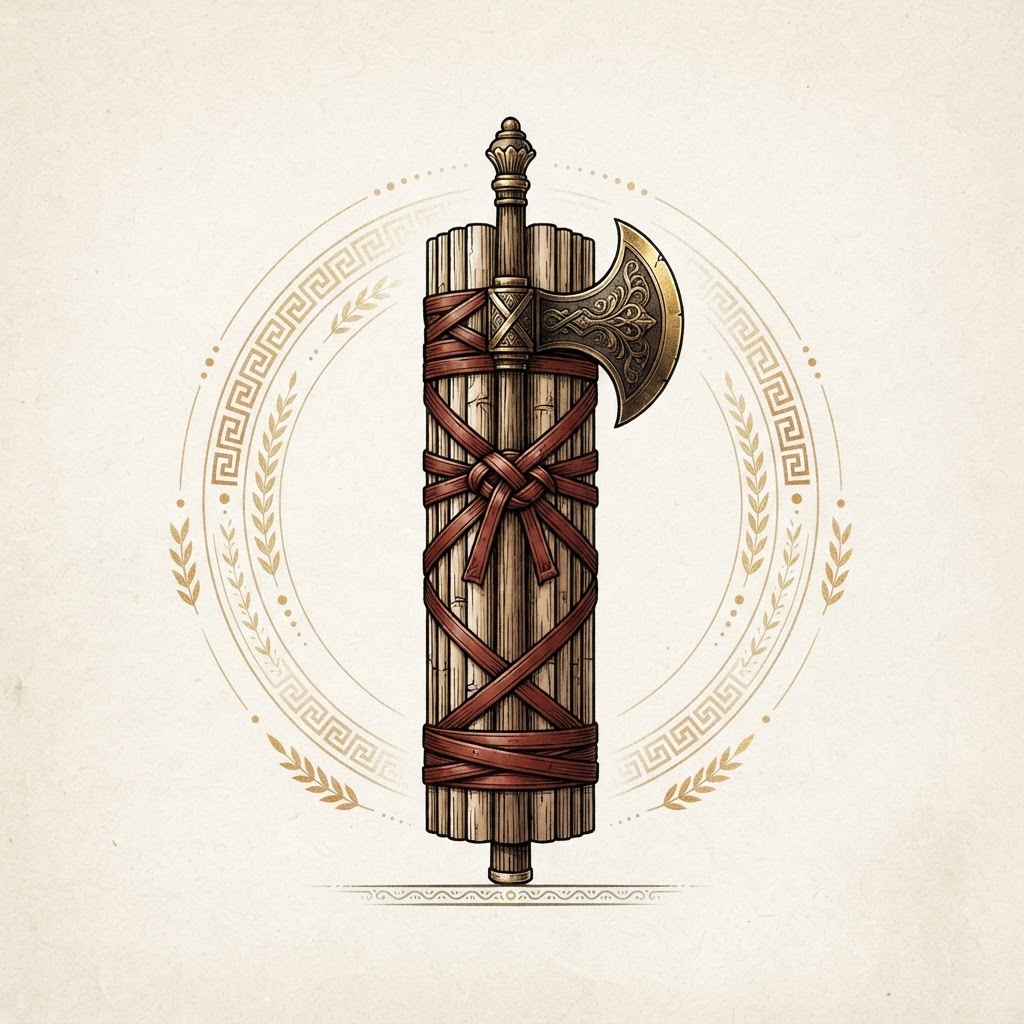
A bundle of birch or elm rods bound with red leather straps around an axe, signifying collective strength, justice, and civic authority.
Quick Facts
- Category
- Greek & Roman
- Culture / Origin
- Etruscan & Roman
- Geographic Origin
- Etruria and Ancient Rome
- Historical Period
- Archaic to Imperial Rome
- Estimated Age
- circa 700 BCE
- Element
- Fire
- Planet
- Mars
- Chakra
- Solar Plexus, Root
- Zodiac
- Capricorn, Aries
- Deities
- Jupiter, Mars, Justitia
- Verification
- unverified
What is Fasces?
The Fasces is an ancient Italic and Roman emblem consisting of a bundle of wooden rods—typically birch or elm—bound tightly with red leather thongs, enclosing a single-headed axe. Carried by attendants known as lictors, the fasces preceded high-ranking Roman magistrates in public appearances.
The symbol originated with the Etruscans and was absorbed into Roman civic and religious governance during the regal and republican eras. It physically embodied the magistrate's 'imperium'—the legal authority to punish citizens through flogging (the rods) or capital punishment (the axe). Inside the sacred boundary of Rome (the pomerium), the axe was removed to honor the citizen's right to appeal.
Beyond raw legal power, the Fasces represents the principle that individual vulnerability is transformed into invincible strength through collective unity, an ideal that later profoundly influenced French Revolutionary and American neoclassical state iconography.
Meaning of Fasces
The Fasces signifies legitimate judicial authority, state sovereignty, collective strength through unity, and the enforcement of law.
Origin & History
Archaeological excavations at the Etruscan city of Vetulonia uncovered an iron miniature fasces dating to the 7th century BCE, confirming its pre-Roman Etruscan origins. Roman historians like Livy recorded that Romulus adopted twelve lictors carrying fasces to signify royal dignity.
Throughout the Roman Republic, the number of fasces carried indicated the official's rank: a praetor had six, a consul twelve, and a dictator twenty-four. The symbol became the hallmark of constitutional law, civic duty, and the defense of the Republic.
Spiritual Meaning
Esoterically, the Fasces conveys the doctrine of unified purpose. A single rod snaps under slight pressure, but many rods bound tightly together withstand immense force, illustrating how the integration of multiple faculties of the self yields unshakeable spiritual discipline.
The axe represents the decisive, discerning mind capable of cutting through delusion and maintaining moral alignment amidst worldly chaos.
Symbolism
The wooden rods signify the individual citizens or collective will bound together; the leather straps signify civic order and harmony; the axe represents discernment, sovereignty, and supreme justice.
Traditional Uses
The official physical emblem of magisterial imperium and the legal right of the Roman state to execute justice and command armies.
Modern Spiritual Uses
Often understood in civic contexts as an icon of democratic solidarity and republican rule of law, though occasionally scrutinized due to 20th-century political appropriations.
Healing Associations
Strengthening mental fortitude, restoring civic resolve, and unifying fragmented internal willpower.
Protection Associations
Invoked historically to protect the legal order, public peace, and communal sovereignty against tyranny or disorder.
How the Symbol Is Used
- •Civic ceremonies
- •Oaths of office
- •Symbolic boundary consecrations
Cultural Context
Etruscan & Roman — Etruria and Ancient Rome (Archaic to Imperial Rome)
Sources & References
- 1.Livy. 'Ab Urbe Condita'. Oxford University Press.
- 2.Marshall, Anthony J. 'Symbols and Showmanship in Roman Public Life'. Phoenix, Classical Association of Canada.
This content is for educational and informational purposes only. Where modern spiritual interpretations are described, they are not presented as ancient historical facts. It is not a substitute for professional medical or spiritual advice.