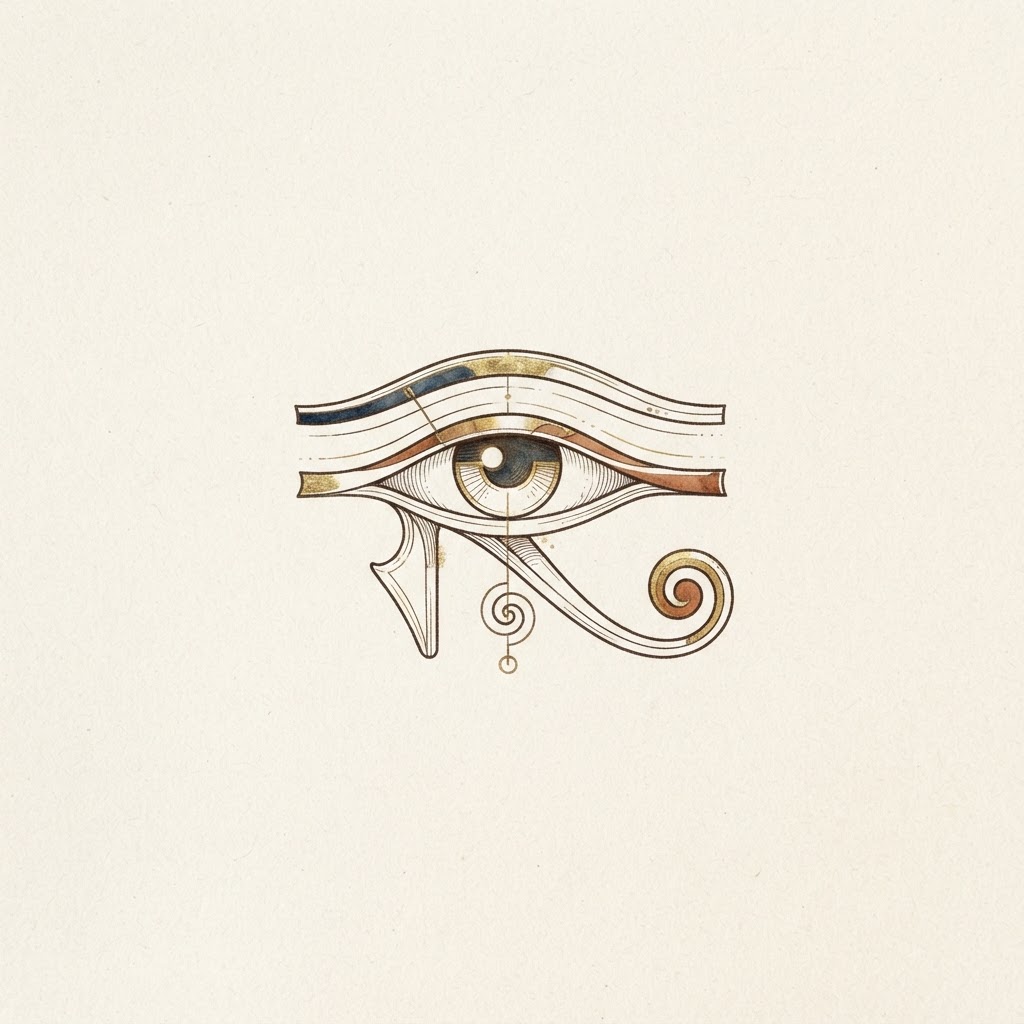
Eye of Horus: Meaning, Origin & Symbolism
Also known as: Wedjat, Udjat, Eye of Ra
Ancient Egyptian
Ancient Egyptian
Third Eye Chakra
Solar Plexus Chakra
Water
Healing
Protection
Wisdom
The Eye of Horus (Wedjat) is a sacred symbol of protection, restoration, royal power, and good health.
Quick Facts
- Category
- Ancient Egyptian
- Culture / Origin
- Ancient Egyptian
- Geographic Origin
- Nile River Valley, Egypt
- Historical Period
- Old Kingdom through Greco-Roman Period
- Estimated Age
- circa 3000 BCE
- Element
- Water
- Planet
- Moon
- Chakra
- Third Eye, Solar Plexus
- Zodiac
- Cancer
- Deities
- Horus, Thoth, Hathor
- Verification
- unverified
What is Eye of Horus?
The Eye of Horus, or Wedjat ('whole' or 'healthy'), is an ancient Egyptian sacred emblem portraying the stylized eye of the sky god Horus, flanked by the facial markings of a falcon. The symbol incorporates teardrop markings and curved flourishes reminiscent of the lanner or peregrine falcon, evoking divine sight and omniscient protection.
According to myth, Horus lost his left eye in a fierce battle against his uncle Set, the god of chaos, who had murdered Horus's father Osiris. The eye was subsequently retrieved, restored, and healed by Thoth, the god of wisdom and medicine. Horus then offered the restored eye to his deceased father to bring him back to life in the underworld.
As a consequence of this myth, the Wedjat became the ultimate Egyptian symbol for healing, wholeness, physical integrity, and protection against malevolent forces. It was widely carved into funerary amulets, painted on the bows of boats for safe passage, and wrapped into mummy bandages to safeguard the deceased.
Meaning of Eye of Horus
The primary meaning of the Eye of Horus is wholeness, healing, complete restoration, and apotropaic divine protection.
Origin & History
The Wedjat was one of the most prolific amulets in ancient Egypt. Its visual segments were famously used in Egyptian mathematics to denote fractions of volume (the hekat), with the components adding up to 63/64, the missing 1/64 representing the magic of Thoth.
It was placed upon the left side of the body of the deceased during mummification to protect the incision through which internal organs were removed, ensuring spiritual and bodily reintegration.
Spiritual Meaning
On a spiritual level, the Wedjat symbolizes the triumph of order (Ma'at) over disorder and chaos (Isfet). It speaks to the journey of psychic injury, sacrifice, and the subsequent restoration of spiritual vision.
It represents the gift of spiritual perception, inner awakening, and the assurance that what has been fragmented in life will be made whole again in the divine order.
Symbolism
The human eye represents conscious awareness, the falcon markings symbolize celestial majesty and elevated perspective, and the curled lower line reflects the spiral of transformation and divine math.
Traditional Uses
Ancient Egyptians interpreted the Wedjat as an omnipotent ward against the evil eye, sickness, and destructive forces in both the earthly realm and the underworld.
Modern Spiritual Uses
Modern esotericists and wellness seekers view the symbol as an emblem of psychic vision, clairvoyance, somatic healing, and a reminder of wholeness after emotional trauma.
Healing Associations
Regarded as the quintessential healer's emblem for restoring physical health, sight, and mental wholeness.
Protection Associations
Primary apotropaic amulet used to repel the evil eye, curses, theft, and physical assault.
How the Symbol Is Used
- •Amulet carving
- •Chakra balancing
- •Vision meditation
Cultural Context
Ancient Egyptian — Nile River Valley, Egypt (Old Kingdom through Greco-Roman Period)
Sources & References
- 1.Pinch, Geraldine. 'Egyptian Mythology: A Guide to the Gods, Goddesses, and Traditions of Ancient Egypt.' Oxford University Press, 2004.
- 2.Robins, Gay. 'The Art of Ancient Egypt.' Harvard University Press, 2008.
This content is for educational and informational purposes only. Where modern spiritual interpretations are described, they are not presented as ancient historical facts. It is not a substitute for professional medical or spiritual advice.