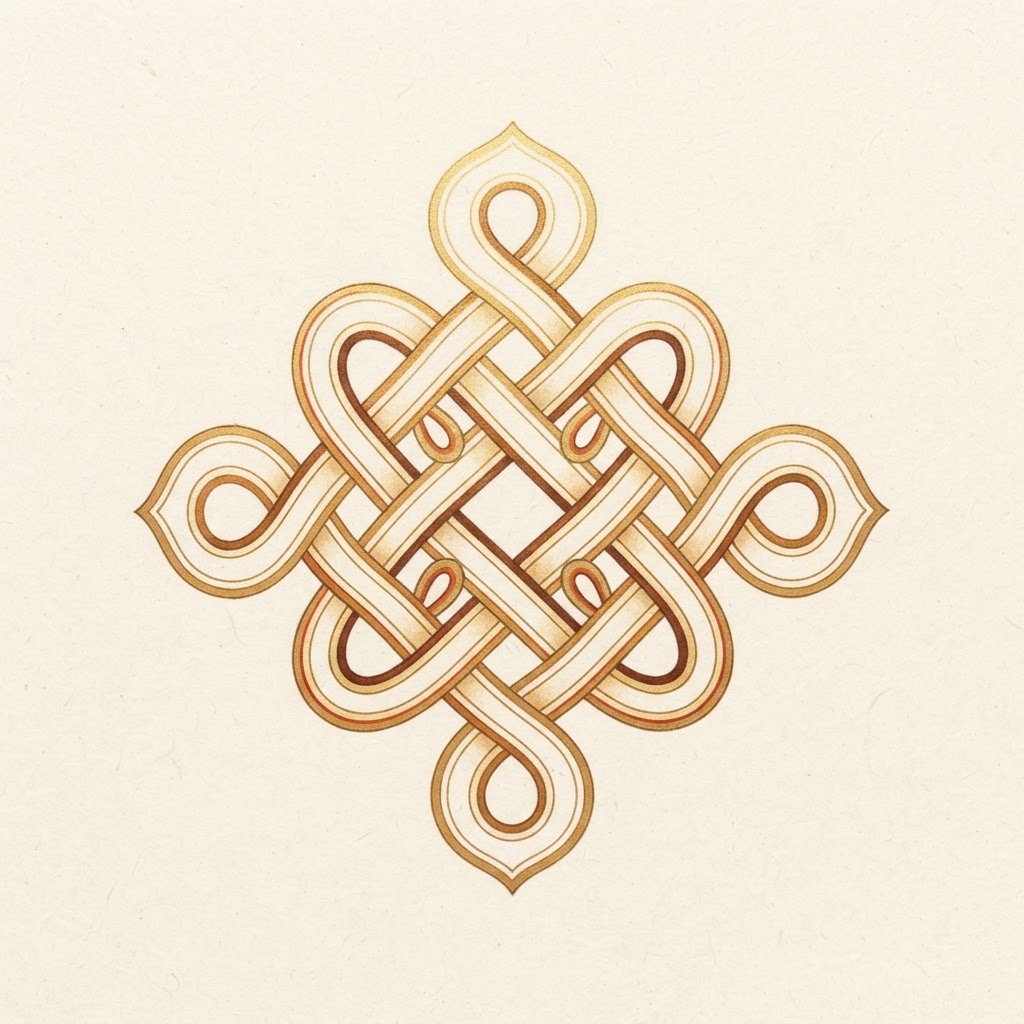
Endless Knot: Meaning, Origin & Symbolism
Also known as: Shrivatsa, Eternal Knot, Glorious Knot
Buddhist
Buddhist
Heart Chakra
Third Eye Chakra
Ether/Spirit
Harmony
Wisdom
Unity
Balance
An intertwined geometric knot without beginning or end, representing the interconnected nature of all phenomena and ultimate wisdom.
Quick Facts
- Category
- Buddhist
- Culture / Origin
- Buddhist
- Geographic Origin
- Ancient India / Tibet
- Historical Period
- Iron Age
- Estimated Age
- circa 2500 BCE
- Element
- Ether/Spirit
- Chakra
- Heart, Third Eye
- Deities
- Gautama Buddha, Manjushri
- Verification
- unverified
What is Endless Knot?
The Endless Knot, known in Sanskrit as Shrivatsa and in Tibetan as Dpal be'u, is one of the Eight Auspicious Symbols (Ashtamangala) in Buddhism. Characterized by interweaving lines that flow smoothly without a discernible beginning or end, it serves as a profound visual meditation on eternity, unity, and the interrelation of all things.
In Vajrayana Buddhist philosophy, the knot illustrates the union of dualities that are often perceived as opposites: wisdom and compassion, the absolute and the relative, and method and insight. Because its lines are inseparable, it shows that neither compassion nor wisdom can function properly without the other on the path to liberation.
Meaning of Endless Knot
The Endless Knot symbolizes the interdependence of all phenomena and the eternal continuum of wisdom and compassion.
Origin & History
The knot originated as an ancient Indian mark of good fortune found on early seals in the Indus Valley and later associated with Vishnu's chest as the Shrivatsa. When integrated into early Buddhist traditions, it lost its anthropomorphic roots and shifted into an abstract depiction of the Buddha's boundless mind, eventually becoming central to Tibetan sacred art and architecture.
Spiritual Meaning
Spiritually, the knot represents the cosmic principle of Pratityasamutpada (dependent origination)—the truth that all reality is co-arising and non-dual. It embodies the continuum of mind (citta-santana) that persists beyond individual lifetimes.
Symbolism
The unbroken lines demonstrate the endless cycle of time and the unity of spiritual striving. The absence of start or finish indicates the infinite nature of the Buddha's wisdom.
Traditional Uses
Historically understood as an auspicious mark adorning the Buddha's body, reflecting his omniscient comprehension of the causes and conditions governing existence.
Modern Spiritual Uses
In modern discourse, it is celebrated as an emblem of holistic interconnectedness, ecological awareness, and the karmic ripples produced by every individual action.
Healing Associations
Restores holistic balance, reconciles internal psychological conflict, and promotes mental cohesion.
Protection Associations
Guards against fragmented thinking, discord, and unskillful karmic entanglements.
How the Symbol Is Used
- •Mandala construction
- •Ritual blessings
- •Mindfulness of interconnectedness
- •Auspicious home protection
Cultural Context
Buddhist — Ancient India / Tibet (Iron Age)
Sources & References
- 1.The Encyclopedia of Tibetan Symbols and Motifs by Robert Beer
- 2.Buddhist Symbols in Tibetan Culture by Dagyab Rinpoche
- 3.Iconography of Religions by Albert C. Moore
This content is for educational and informational purposes only. Where modern spiritual interpretations are described, they are not presented as ancient historical facts. It is not a substitute for professional medical or spiritual advice.