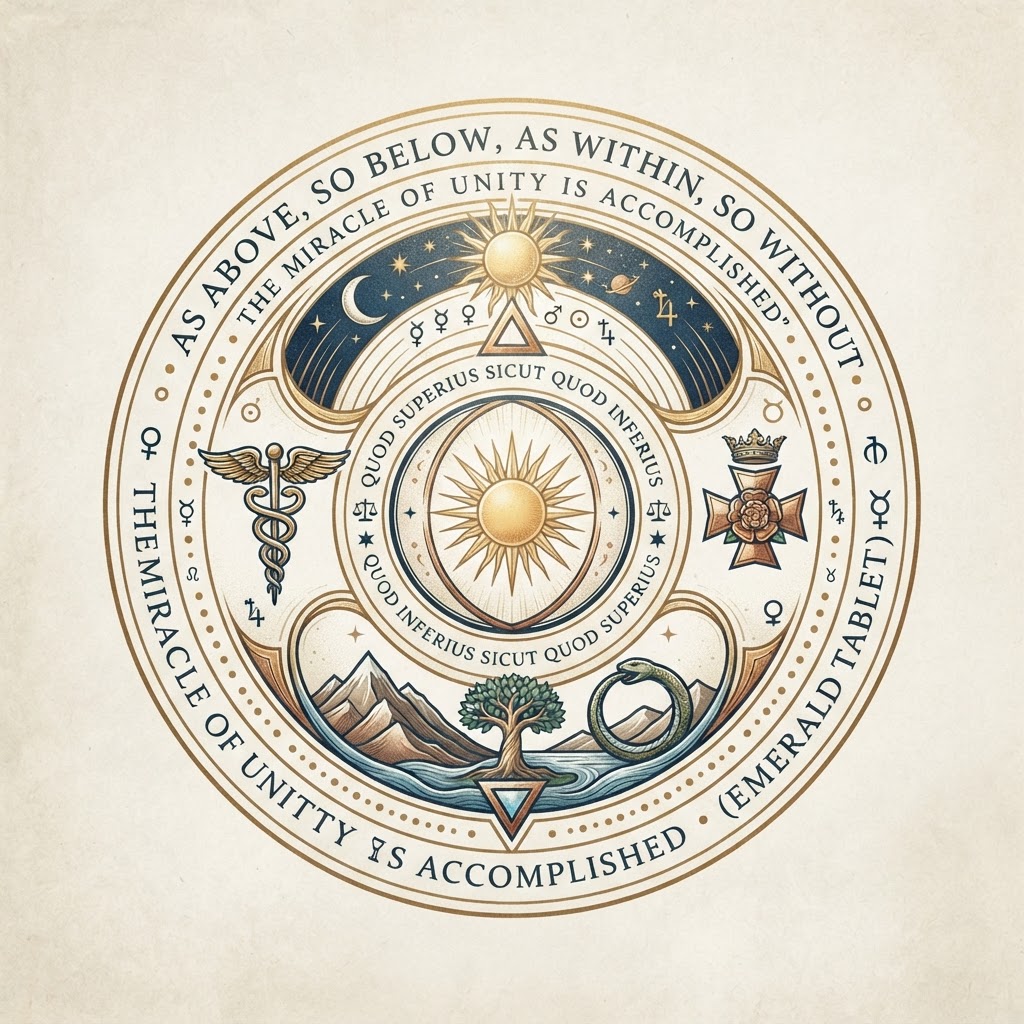
Seal of the Emerald Tablet: Meaning, Origin & Symbolism
Also known as: Tabula Smaragdina Emblem, Hermetic Seal of Hermes, Seal of the Smaragdine Tablet
Hermetic
Hellenistic / European Hermeticism
Heart Chakra
Third Eye Chakra
Crown Chakra
Ether/Spirit
Wisdom
Manifestation
Transformation
Balance
A composite symbolic seal encapsulating the core Hermetic axiom: As above, so below, as within, so without.
Quick Facts
- Category
- Hermetic
- Culture / Origin
- Hellenistic / European Hermeticism
- Geographic Origin
- Egypt and Western Europe
- Historical Period
- Early Medieval to Renaissance
- Estimated Age
- circa 800 CE (textual roots), 1600 CE (iconography)
- Element
- Ether/Spirit
- Planet
- Sun
- Chakra
- Heart, Third Eye, Crown
- Zodiac
- Leo, Aquarius
- Deities
- Hermes Trismegistus, Thoth
- Verification
- unverified
What is Seal of the Emerald Tablet?
The Seal of the Emerald Tablet is a synthesized Hermetic visual emblem derived from the legendary text attributed to Hermes Trismegistus, the Tabula Smaragdina. The seal typically features intertwined celestial and terrestrial motifs, often framing the sun, the moon, the five classical planets, and alchemical apparatus around a central unitive point. It stands as the quintessential visual summary of Hermetic cosmology, articulating how the macrocosm and microcosm mirror one another.
While the text of the Emerald Tablet is ancient, the visual seal evolved through centuries of European alchemical iconography, reaching its pinnacle in the woodcuts of Heinrich Khunrath's Amphitheatrum Sapientiae Aeternae and Daniel Mylius's treatises. The seal serves not merely as decoration, but as an operative contemplative mandala that visually encodes the stages of spiritual transmutation, celestial influence, and elemental synthesis required to create the Philosopher's Stone.
Meaning of Seal of the Emerald Tablet
The seal expresses the foundational Hermetic principle of universal correspondence: that the heavenly realm and the earthly domain operate under identical cosmic laws.
Origin & History
The root text of the Emerald Tablet first surfaced in written form in Arabic treatises such as the Kitab Sirr al-Khaliqa (Book of the Secret of Creation) attributed to Balinas (Apollonius of Tyana) around the 8th century CE. It claimed to be the rediscovered wisdom of Hermes Trismegistus, inscribed on an emerald slab with a diamond stylus. Translated into Latin in the 12th century by Philip of Tripoli, it electrified medieval and Renaissance philosophers.
Artists and occultists subsequently created intricate cryptographic seals to encode its brief, enigmatic maxims. Figures such as Isaac Newton, Johannes Schöner, and Robert Fludd analyzed these glyphs intensely. The seal distilled the written Latin aphorisms into a single, cohesive geometric and planetary framework that an alchemist could hold in their mind's eye during laboratory operations.
Spiritual Meaning
Spiritually, the Seal of the Emerald Tablet is an instrument for realizing non-dual awareness within the matrix of physical form. It reminds the seeker that human consciousness (the microcosm) contains all the powers, celestial patterns, and archetypes of the universe itself (the macrocosm). By purifying the inner elements, the adept effects change in the external world.
The symbol serves as a guide for descending into the depths of matter and returning to the pure light of the divine. It teaches that spiritual liberation does not require an escape from the physical world, but rather the illumination and sanctification of matter through divine awareness, uniting the sun of consciousness with the moon of intuition.
Symbolism
The upward and downward triangles or pointers indicate the descent of spirit and ascent of matter; the seven planetary symbols mark the phases of interior development; the central focal point symbolizes the unmoving divine source, the 'One Thing' from which all manifested reality proceeds.
Traditional Uses
Traditionally read as the recipe for the Magnum Opus, illustrating how celestial virtues descend upon terrestrial elements through the operations of the Sun (Father), Moon (Mother), and Wind (carrier).
Modern Spiritual Uses
Interpreted by modern thinkers as an archetype of holistic interconnectedness, cognitive integration, and the psychological resonance between internal mindset and external reality.
Healing Associations
Employed to restore balance between psychological archetypes and align one's biorhythms with cosmic and planetary cycles.
How the Symbol Is Used
- •Spiritual Alchemy
- •Meditation
- •Hermetic Contemplation
- •Astrological Theurgy
Cultural Context
Hellenistic / European Hermeticism — Egypt and Western Europe (Early Medieval to Renaissance)
Sources & References
- 1.Kitab Sirr al-Khaliqa (attributed to Apollonius of Tyana)
- 2.The Emerald Tablet of Hermes (Latin translations by Chrysogonus Polydorus, 1541)
- 3.Hermetica by Brian P. Copenhaver
This content is for educational and informational purposes only. Where modern spiritual interpretations are described, they are not presented as ancient historical facts. It is not a substitute for professional medical or spiritual advice.