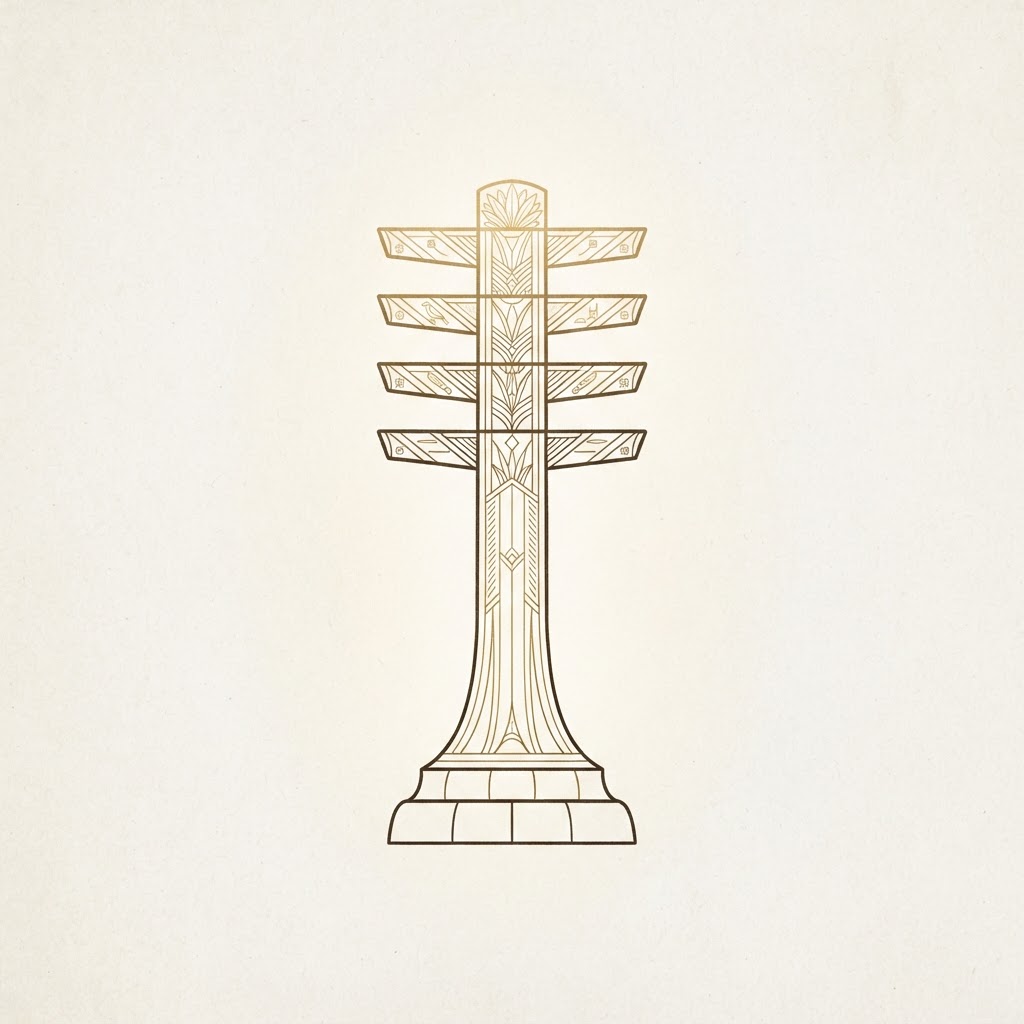
Djed Pillar: Meaning, Origin & Symbolism
Also known as: Backbone of Osiris, Pillar of Stability
Ancient Egyptian
Ancient Egyptian
Root Chakra
Crown Chakra
Earth
Protection
Transformation
Wisdom
The Djed Pillar is an ancient Egyptian symbol representing stability, endurance, and the spine of Osiris.
Quick Facts
- Category
- Ancient Egyptian
- Culture / Origin
- Ancient Egyptian
- Geographic Origin
- Memphis and Abydos, Egypt
- Historical Period
- Predynastic through Roman Period
- Estimated Age
- circa 3200 BCE
- Element
- Earth
- Planet
- Saturn
- Chakra
- Root, Crown
- Zodiac
- Capricorn
- Deities
- Osiris, Ptah, Sokar
- Verification
- unverified
What is Djed Pillar?
The Djed Pillar is an architectural and spiritual hieroglyph featuring a vertical column crossed by four horizontal registers near the top. Historically linked with Ptah, the creator god of Memphis, and Sokar, it eventually became firmly unified with Osiris, representing the deity's backbone and his enduring power after overcoming death.
The ritual known as the 'Raising of the Djed' was a pivotal ceremony performed during royal jubilees (the Sed festival) and coronation rites. By raising the pillar upright using ropes, the Pharaoh symbolically restored balance to the cosmos, defeated disorder, and resurrected the authority of Osiris in the living world.
Amuletic Djeds were frequently fashioned from blue or green glazed faience and placed along the backbone of mummies. This placement ensured that the deceased would possess a strong spinal cord, the ability to stand upright in the realm of the dead, and the enduring vitality of the resurrected god.
Meaning of Djed Pillar
The primary meaning of the Djed is stability, permanence, endurance, and the restoration of structural order.
Origin & History
Originally interpreted as a sheaf of grain stalks or a lopped tree trunk associated with agricultural fertility, the Djed became closely aligned with funerary cults in Abydos.
Chapter 155 of the Egyptian Book of the Dead explicitly directs that a gold Djed amulet be dipped in juice of the ankham-flower, consecrated, and laid at the neck of the deceased to provide eternal stability.
Spiritual Meaning
Spiritually, the Djed signifies the inner axis of the soul—the central pillar of consciousness that remains unshakable amidst worldly turmoil.
It represents spiritual alignment, grounded willpower, and the unyielding strength required to rise again after experiencing profound defeat or disintegration.
Symbolism
The vertical shaft represents the human spine and cosmic axis (axis mundi), while the four horizontal crossbars represent the vertebrae or the four cardinal directions and levels of creation.
Traditional Uses
Understood in ancient religion as the literal and metaphorical stabilization of Osiris's resurrected body and the continuity of the cosmic world order.
Modern Spiritual Uses
In modern esoteric systems, the Djed is often correlated with the human spinal column, Kundalini ascension, and the alignment of the chakras along the central energetic channel.
Healing Associations
Applied in vibrational therapy to heal spinal conditions, posture, and neurological stability.
Protection Associations
Guards the physical spine against paralysis and preserves the subtle body against energetic collapse.
How the Symbol Is Used
- •Spine alignment meditation
- •Energy grounding
- •Reiki
Cultural Context
Ancient Egyptian — Memphis and Abydos, Egypt (Predynastic through Roman Period)
Sources & References
- 1.Faulkner, Raymond O. 'The Ancient Egyptian Book of the Dead.' British Museum Publications, 1985.
- 2.Wilkinson, Richard H. 'The Complete Gods and Goddesses of Ancient Egypt.' Thames & Hudson, 2003.
This content is for educational and informational purposes only. Where modern spiritual interpretations are described, they are not presented as ancient historical facts. It is not a substitute for professional medical or spiritual advice.