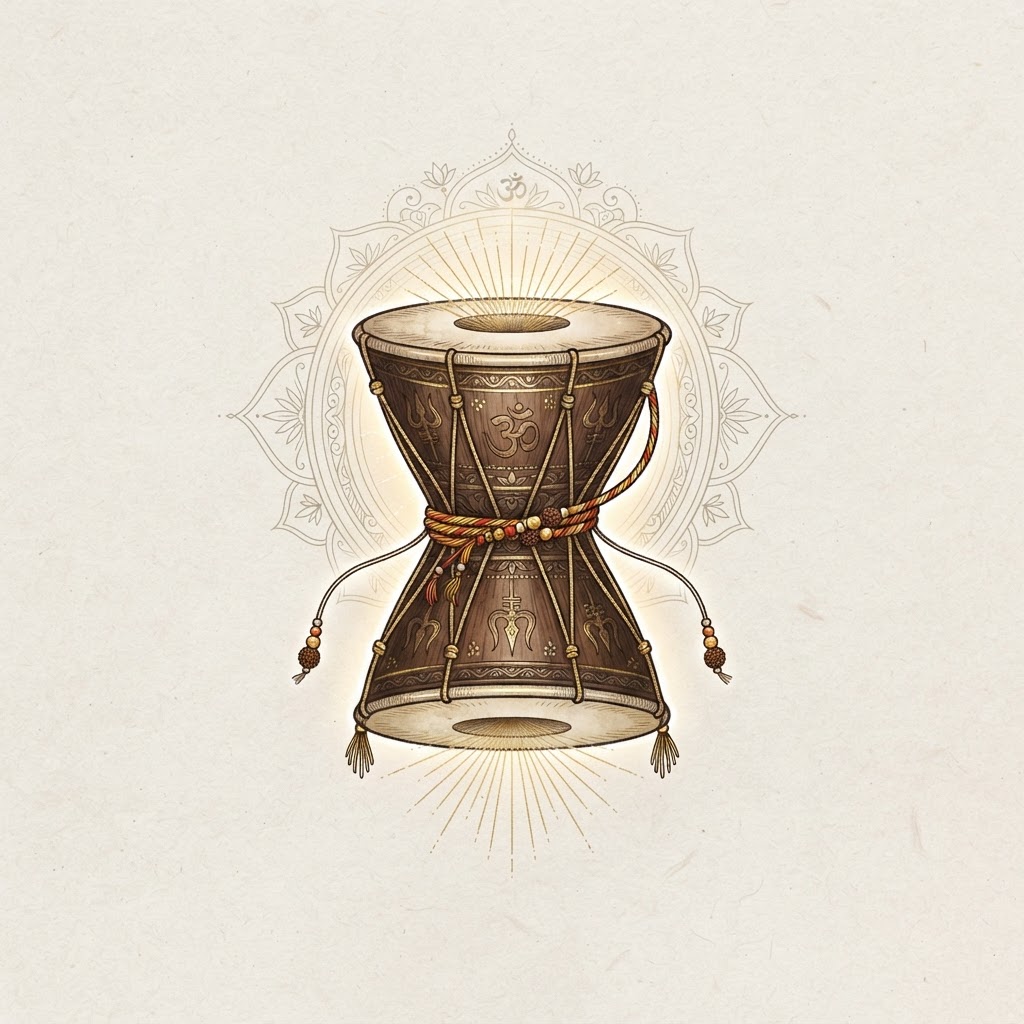
Damaru: Meaning, Origin & Symbolism
Also known as: Damru, Shiva's Drum
Hindu
Hindu
Throat Chakra
Ether/Spirit
Transformation
Wisdom
Harmony
The hourglass-shaped rattle drum of Lord Shiva that produces the primordial rhythm of cosmic creation and dissolution.
Quick Facts
- Category
- Hindu
- Culture / Origin
- Hindu
- Geographic Origin
- Indian Subcontinent
- Historical Period
- Classical Antiquity
- Estimated Age
- circa 1000 BCE
- Element
- Ether/Spirit
- Planet
- Mercury
- Chakra
- Throat
- Zodiac
- Gemini, Virgo
- Deities
- Shiva, Nataraja
- Verification
- unverified
What is Damaru?
The Damaru is a small, two-headed hourglass drum associated inextricably with Lord Shiva, especially in his manifestation as Nataraja, the Cosmic Dancer. Held in his upper right hand, it generates the primordial rhythmic pulse that sets the cosmic dance of creation and dissolution into motion.
Constructed with an hourglass wooden or bronze frame, leather drumheads, and knotted strings that strike the skins when shaken, the drum produces a continuous acoustic oscillation. This rhythm echoes the ceaseless expansion and contraction of space and time.
In classical linguistic and spiritual lore, the drumbeats of the Damaru revealed the fundamental phonemes of the Sanskrit language to the ancient grammarian Panini, linking musical rhythm with divine speech.
Meaning of Damaru
The primordial rhythmic pulse of time, cosmic speech, and the ongoing dance of creation.
Origin & History
The Damaru has prehistoric roots as an indigenous tribal instrument before being integrated into mainstream Puranic literature and temple iconography across India.
From the 6th to the 10th centuries CE, the Chola bronze sculptures immortalized the Damaru held high in Nataraja's hand, embodying the cosmological balance between acoustic creation and consuming fire.
Spiritual Meaning
The Damaru represents the rhythmic vibration (Spanda) that underlies all material reality. Everything in the cosmos vibrates, oscillating between manifest existence and latent potential.
Meditating on its rhythm aligns the individual heart rate and breath cycles with the larger cosmic pulse, inducing a state of rhythmic presence.
Symbolism
The hourglass structure symbolizes the convergence of opposites: the upper half signifies the manifest world, while the lower half denotes the unmanifest realm, meeting at the narrow point of present awareness. The two striking strikers represent duality resolving into one sound.
Traditional Uses
The sacred source of Nada Brahma (sound as God) and the origin of the 14 Shiva Sutras, which formed the grammatical and mystical foundation of Sanskrit.
Modern Spiritual Uses
Often used in sound healing and movement therapies as a symbol of life's natural rhythms, cyclical seasons, and acoustic healing.
Healing Associations
Assists in sound-frequency therapies to synchronize brainwaves and release psychosomatic stress.
Protection Associations
Drives away lethargy, psychic torpor, and stagnant ambient energies through vibrant sound resonance.
How the Symbol Is Used
- •Nada Yoga
- •Tantric ritual music
- •Shiva Tandava recitations
Cultural Context
Hindu — Indian Subcontinent (Classical Antiquity)
Sources & References
- 1.The Dance of Shiva by Ananda K. Coomaraswamy
- 2.Sanskrit and the Sacred Word by Frits Staal
This content is for educational and informational purposes only. Where modern spiritual interpretations are described, they are not presented as ancient historical facts. It is not a substitute for professional medical or spiritual advice.