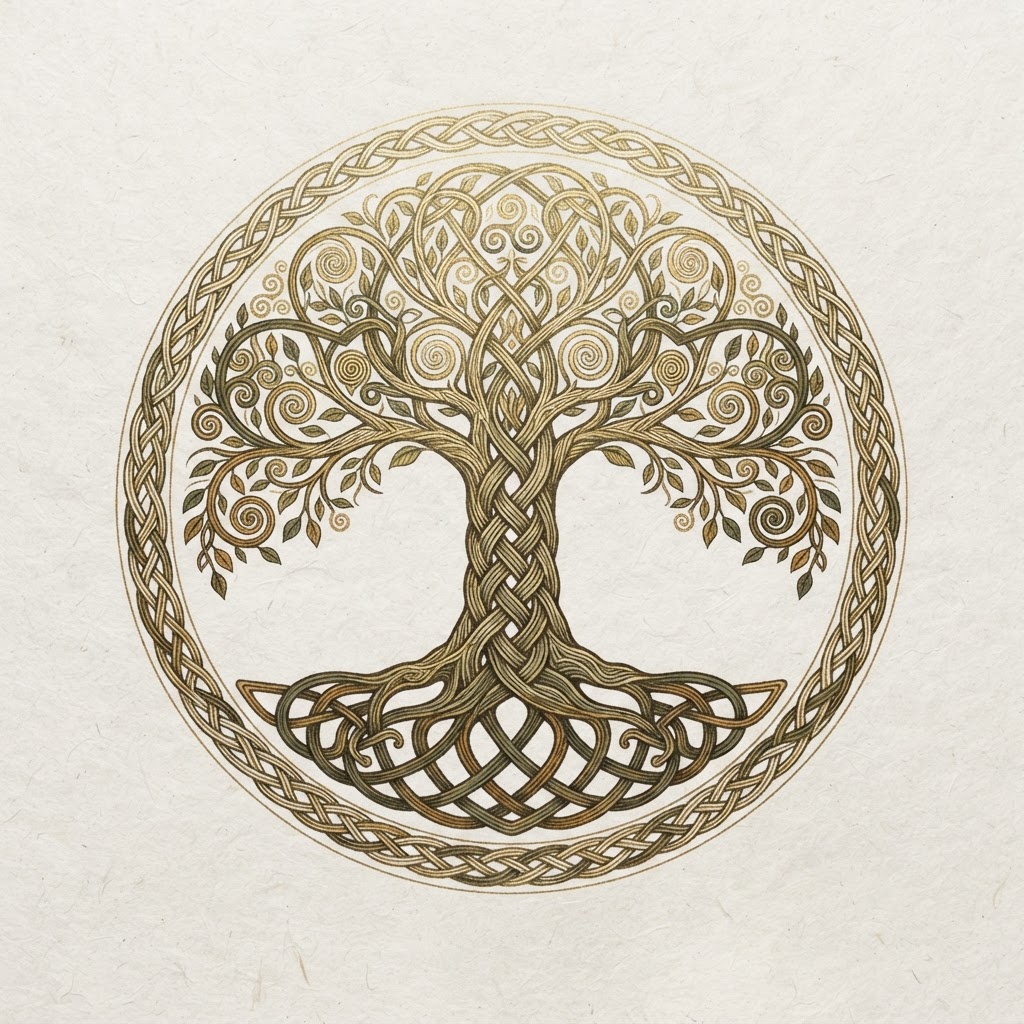
Crann Bethadh: Meaning, Origin & Symbolism
Also known as: Celtic Tree of Life
Celtic
Celtic
Root Chakra
Crown Chakra
Earth
Wisdom
Healing
Protection
Balance
The Celtic Tree of Life, whose branches reach into the sky while roots anchor into the underworld, uniting all realms.
Quick Facts
- Category
- Celtic
- Culture / Origin
- Celtic
- Geographic Origin
- Ancient Gaul, Ireland, and Britain
- Historical Period
- Iron Age to Medieval
- Estimated Age
- circa 500 BCE
- Element
- Earth
- Planet
- Jupiter
- Chakra
- Root, Crown
- Zodiac
- Taurus, Virgo, Capricorn
- Deities
- Danu, The Dagda, Cernunnos
- Verification
- unverified
What is Crann Bethadh?
The Crann Bethadh, or Celtic Tree of Life, is an evocative motif portraying a towering tree whose leafy boughs ascend into the upper heavens while its dense root system weaves deep into the subterranean earth. In Celtic ornamental art, the branches and roots often entwine into continuous, unbroken knotwork, visually expressing the perpetual unity of all worldly and metaphysical realms.
To the ancient Celts, trees were not passive landscape features; they were sentient beings, spiritual shelters, and sacred custodians of tribal identity. Clearing land around a single magnificent oak (the crann bethadh) was essential when establishing a settlement, creating an axis around which communal laws were decreed, kings inaugurated, and assemblies held.
Represented in wood, stone, and bronze, the Crann Bethadh encapsulates complete cosmic balance. It mirrors human existence, standing firmly planted in physical reality while continuously yearning upward toward greater wisdom and spiritual illumination.
Meaning of Crann Bethadh
The Crann Bethadh represents the interconnectedness of all life forms, bridging the underworld, physical existence, and the heavens.
Origin & History
Dendrolatry (tree veneration) is widely documented among Celtic populations by classical writers such as Pliny the Elder and Lucan, who noted that Druids conducted sacred rites within untouched oak groves known as nemetons. Trees like the oak, hazel, ash, and yew were guarded under stringent early legal codes, such as the Brehon laws in Ireland, which penalized unauthorized felling.
During warfare, felling an enemy clan's sacred Crann Bethadh was considered the ultimate spiritual and psychological defeat, as it stripped the community of its vital protective axis. In later Insular knotwork, the motif was stylized into infinite interlacing foliage and vine designs.
Spiritual Meaning
Spiritually, the tree embodies resilience, ancestral heritage, and continual rebirth through the seasonal cycles of shedding, dormancy, budding, and fruiting. Its roots draw vitality and wisdom from the ancestors resting in the earth, while its canopy receives illumination from celestial heights.
It also reflects the internal energetic system of human consciousness: maintaining rootedness and stability in one's earthly life while expanding thoughts and aspirations into higher realms of spiritual connection.
Symbolism
Roots symbolize ancestry, past wisdom, and connection to the underworld; the trunk represents physical life and strength; the branches reflect aspirations, the upper cosmos, and spiritual destiny.
Traditional Uses
Regarded as the heart and life-giver of the tribe, providing shelter, counsel, and direct communion between mortal chieftains and the divine.
Modern Spiritual Uses
Seen today as an environmental archetype of ecological unity, holistic personal growth, and spiritual grounding.
Healing Associations
Used in energy work to support nervous system stabilization, physical endurance, and deep ancestral healing.
Protection Associations
Invoked to create safe, sacred spaces and to ground volatile or overwhelming energetic currents.
How the Symbol Is Used
- •Tree Ogham Meditation
- •Nature Communion
- •Ancestral Healing
- •Grounding Practices
Cultural Context
Celtic — Ancient Gaul, Ireland, and Britain (Iron Age to Medieval)
Sources & References
- 1.Mac Cana, Proinsias. 'Celtic Mythology.' Hamlyn, 1970.
- 2.Pennick, Nigel. 'The Celtic Cross: An Illustrated History and Celebration.' Blandford, 1997.
This content is for educational and informational purposes only. Where modern spiritual interpretations are described, they are not presented as ancient historical facts. It is not a substitute for professional medical or spiritual advice.