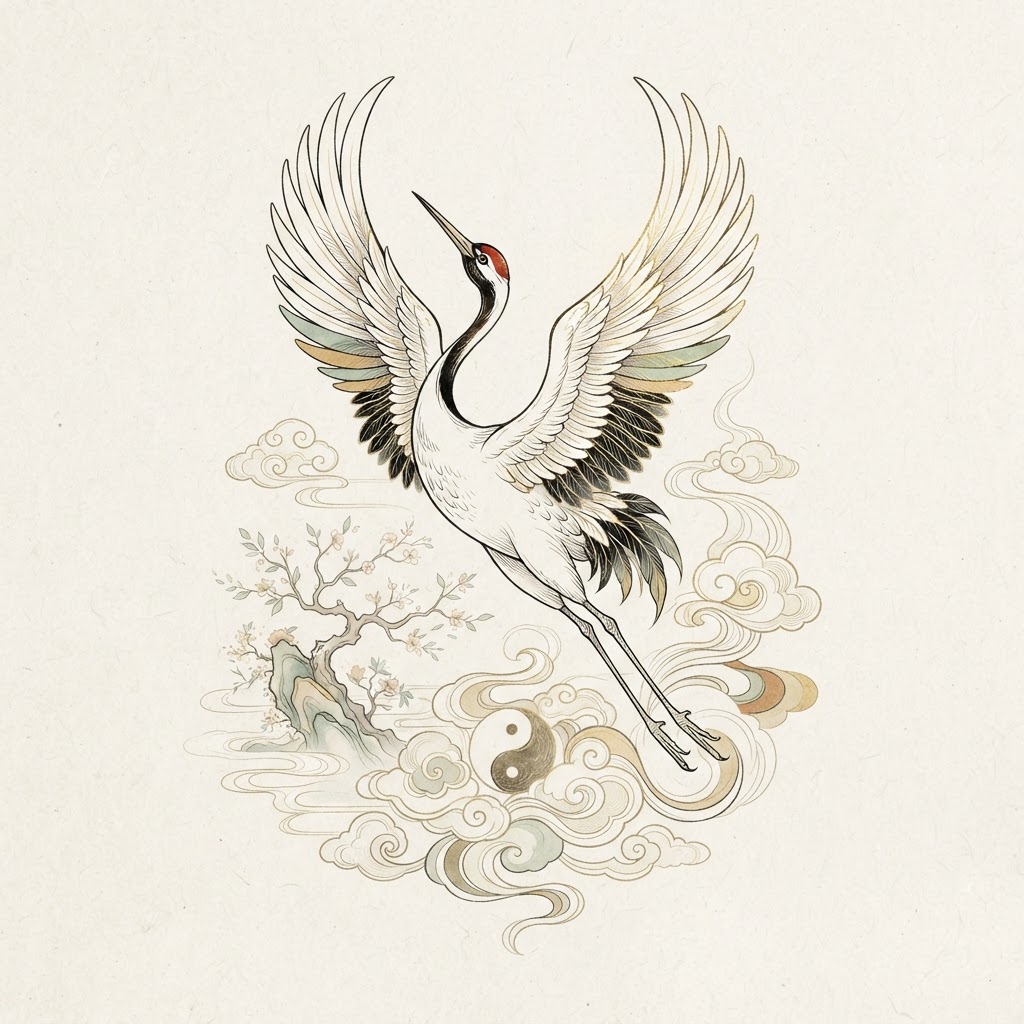
Crane (Xianhe): Meaning, Origin & Symbolism
Also known as: Immortal Crane, Red-Crowned Crane, Daoist Crane
Taoist/Chinese
Taoist/Chinese
Throat Chakra
Crown Chakra
Air
Wisdom
Transformation
Peace
Healing
An elegant water bird symbolizing spiritual elevation, longevity, moral integrity, and the flight to the immortal realms.
Quick Facts
- Category
- Taoist/Chinese
- Culture / Origin
- Taoist/Chinese
- Geographic Origin
- China
- Historical Period
- Shang Dynasty to Han Dynasty
- Estimated Age
- circa 1500 BCE
- Element
- Air
- Planet
- Mercury
- Chakra
- Throat, Crown
- Deities
- Lu Dongbin, Three Pure Ones, Yellow Emperor
- Verification
- unverified
What is Crane (Xianhe)?
The Crane, specifically the red-crowned crane (Grus japonensis), holds a revered position in Taoist mythology and Chinese art as the primary avian emblem of immortality and spiritual transcendence. Known as Xianhe ('Immortal Crane'), this magnificent bird is celebrated for its graceful demeanor, snow-white plumage, and remarkable longevity in the wild. In Taoist lore, cranes serve as the loyal celestial mounts upon which Daoist immortals, sages, and deities ride as they travel between the earthly world and heavenly spheres. Legends frequently recount enlightened masters shedding their physical forms at the end of their lives, transforming into magnificent white cranes to soar effortlessly into the void of the Dao.
Meaning of Crane (Xianhe)
Longevity, spiritual ascent, noble character, and the freedom of the enlightened soul.
Origin & History
Crane bones were fashioned into ritual flutes during the early Neolithic era at Jiahu (c. 7000 BCE), showing an ancient spiritual connection to birds in Chinese territory. By the Han and Tang dynasties, the crane was deeply integrated into the institutional Daoist imaginary. Paintings from the Tang and Song dynasties consistently depict cranes flocking around temple roofs or accompanying the Three Pure Ones. Along with the pine tree, the crane became the preeminent visual metaphor for enduring life and steadfast spiritual virtue.
Spiritual Meaning
The Crane embodies the realization of true spiritual freedom. By rising above earthly waters to traverse the boundless sky, it illustrates the adept's journey of transcending physical limitations and emotional density to dwell in the pure, spacious expanse of Daoist realization.
Symbolism
Its pristine white feathers signify purity of spirit, while its brilliant crimson crown symbolizes concentrated Yang energy and internal alchemical fire. Its pairing with pine trees symbolizes longevity that withstands winter adversity.
Traditional Uses
Revered as an auspicious sign of heavenly approval, moral nobility, and a blessing for long, healthy life.
Modern Spiritual Uses
Embraced as an emblem of graceful aging, mindful living, poise, and ascending beyond day-to-day stress into elevated perspectives.
Healing Associations
Associated with graceful movement, respiratory wellness, deep breathing exercises, and lung meridian health in medical Qigong.
Protection Associations
Displayed in domestic settings to preserve familial peace and protect against early physical decline.
How the Symbol Is Used
- •Qigong (Crane Form)
- •Daoist Meditation
- •Feng Shui
Cultural Context
Taoist/Chinese — China (Shang Dynasty to Han Dynasty)
Sources & References
- 1.Little, Stephen, and Shawn Eichman. Taoism and the Arts of China. Art Institute of Chicago, 2000.
- 2.Eberhard, Wolfram. A Dictionary of Chinese Symbols. Routledge, 1986.
This content is for educational and informational purposes only. Where modern spiritual interpretations are described, they are not presented as ancient historical facts. It is not a substitute for professional medical or spiritual advice.