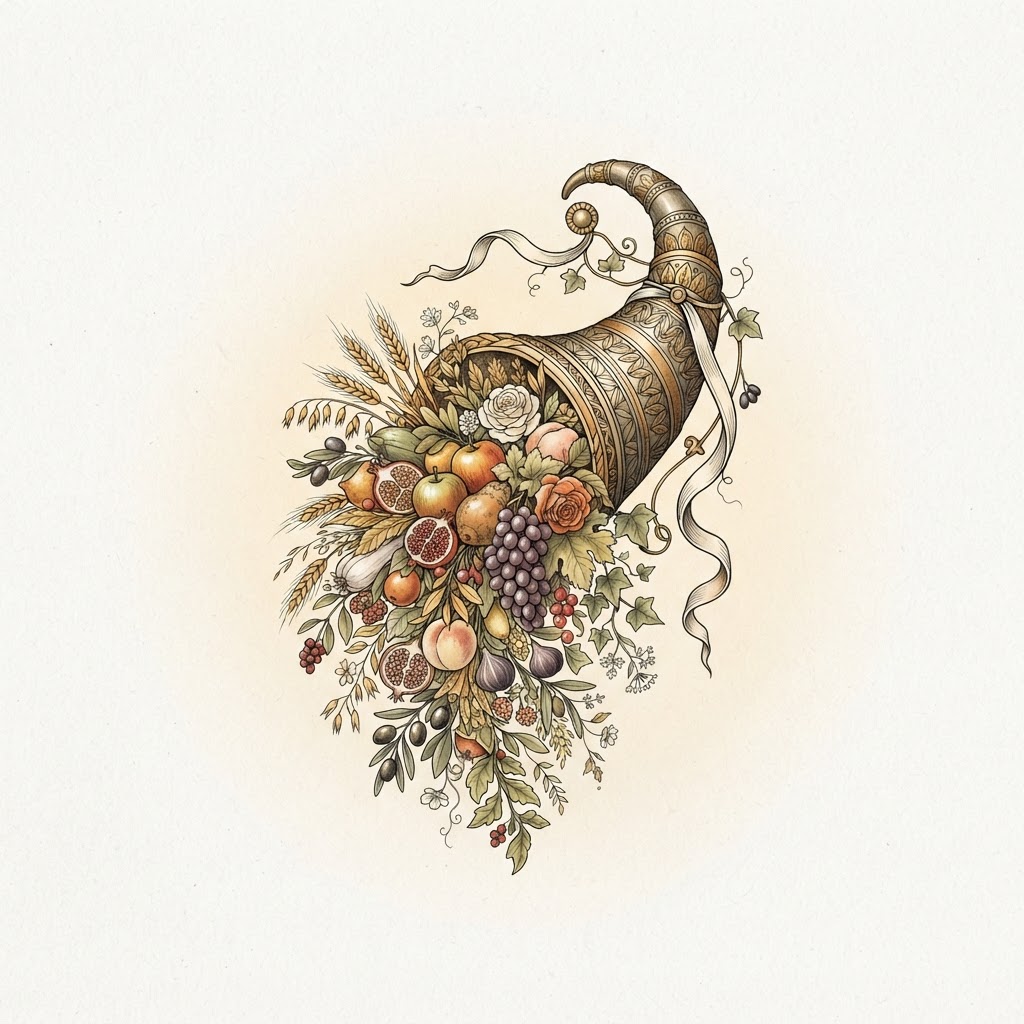
Cornucopia: Meaning, Origin & Symbolism
Also known as: Horn of Plenty, Amalthea's Horn
Greek & Roman
Ancient Greek & Roman
Root Chakra
Solar Plexus Chakra
Earth
Abundance
Gratitude
Prosperity
Manifestation
A horn overflowing with fruits, grains, and flowers, symbolizing endless prosperity, divine abundance, and earthly wealth.
Quick Facts
- Category
- Greek & Roman
- Culture / Origin
- Ancient Greek & Roman
- Geographic Origin
- Crete, Ancient Greece, and Rome
- Historical Period
- Classical to Roman Imperial
- Estimated Age
- circa 8th century BCE
- Element
- Earth
- Planet
- Jupiter
- Chakra
- Root, Solar Plexus
- Zodiac
- Taurus, Sagittarius
- Deities
- Fortuna, Demeter, Ceres, Plutus, Amalthea, Abundantia
- Verification
- unverified
What is Cornucopia?
The Cornucopia, or Horn of Plenty (from the Latin 'cornu copiae'), is one of the most enduring symbols of abundance and prosperity from classical antiquity. Shaped like a curved goat's horn, it is depicted brimming with fresh harvest, pomegranates, grapes, grain sheaves, and overflowing wealth.
In Greek mythology, the symbol originates from the infant Zeus, who was hidden from his father Cronus on Crete and suckled by the divine goat Amalthea. When Amalthea accidentally broke off one of her horns, the infant god blessed it with the power to perpetually flow with whatever nourishment or riches its possessor desired.
Throughout the Hellenistic and Roman worlds, the Cornucopia was held by many foundational deities, including Fortuna (goddess of luck), Ceres (goddess of agriculture), Plutus (god of wealth), and personifications of fruitful provinces. It served as a political and spiritual assurance of peace, security, and agricultural abundance.
Meaning of Cornucopia
The Cornucopia fundamentally denotes infinite material, spiritual, and agricultural abundance, harvest bounty, and good fortune.
Origin & History
The Cornucopia was ubiquitous in Hellenistic royal iconography, particularly among the Ptolemies of Egypt, who depicted twin cornucopias on gold coins to project state stability and boundless royal generosity.
In Rome, it became a standard motif on imperial coinage, temple friezes, and public monuments under Augustus and his successors to signal the return of the 'Golden Age' (Aurea Aetas). It adorned depictions of Pax (Peace), Abundantia (Abundance), and Annona (the grain supply).
Spiritual Meaning
On an esoteric plane, the Cornucopia symbolizes the divine womb of nature and the infinite generative capacity of the cosmos. It teaches that the universe is inherently bountiful rather than scarce, overflowing with life and spiritual sustenance for those aligned with natural cycles.
It serves as a talisman of gratitude, prompting the understanding that true prosperity comes from recognizing and harmonizing with the unending benevolence of the source.
Symbolism
The hollow horn represents receptive female generative power and nature's vessel; the spilling fruits, flowers, and coins denote the unceasing overflow of blessings and sustenance.
Traditional Uses
A tangible promise of agricultural fertility, harvest success, imperial peace, and the benevolence of gods presiding over human livelihood.
Modern Spiritual Uses
Widely utilized in manifestation, gratitude practices, and harvest celebrations as a visual anchor for abundance mindset and prosperity.
Healing Associations
Replenishment of depleted vitality, inner nourishment, and healing feelings of unworthiness.
Protection Associations
Protects against famine, financial loss, deprivation, and scarcity consciousness.
How the Symbol Is Used
- •Harvest rituals
- •Manifestation ceremonies
- •Altar offerings
- •Prosperity blessings
Cultural Context
Ancient Greek & Roman — Crete, Ancient Greece, and Rome (Classical to Roman Imperial)
Sources & References
- 1.Ovid. 'Fasti' and 'Metamorphoses'. Oxford World's Classics.
- 2.Richardson, L. 'A New Topographical Dictionary of Ancient Rome'. Johns Hopkins University Press.
This content is for educational and informational purposes only. Where modern spiritual interpretations are described, they are not presented as ancient historical facts. It is not a substitute for professional medical or spiritual advice.