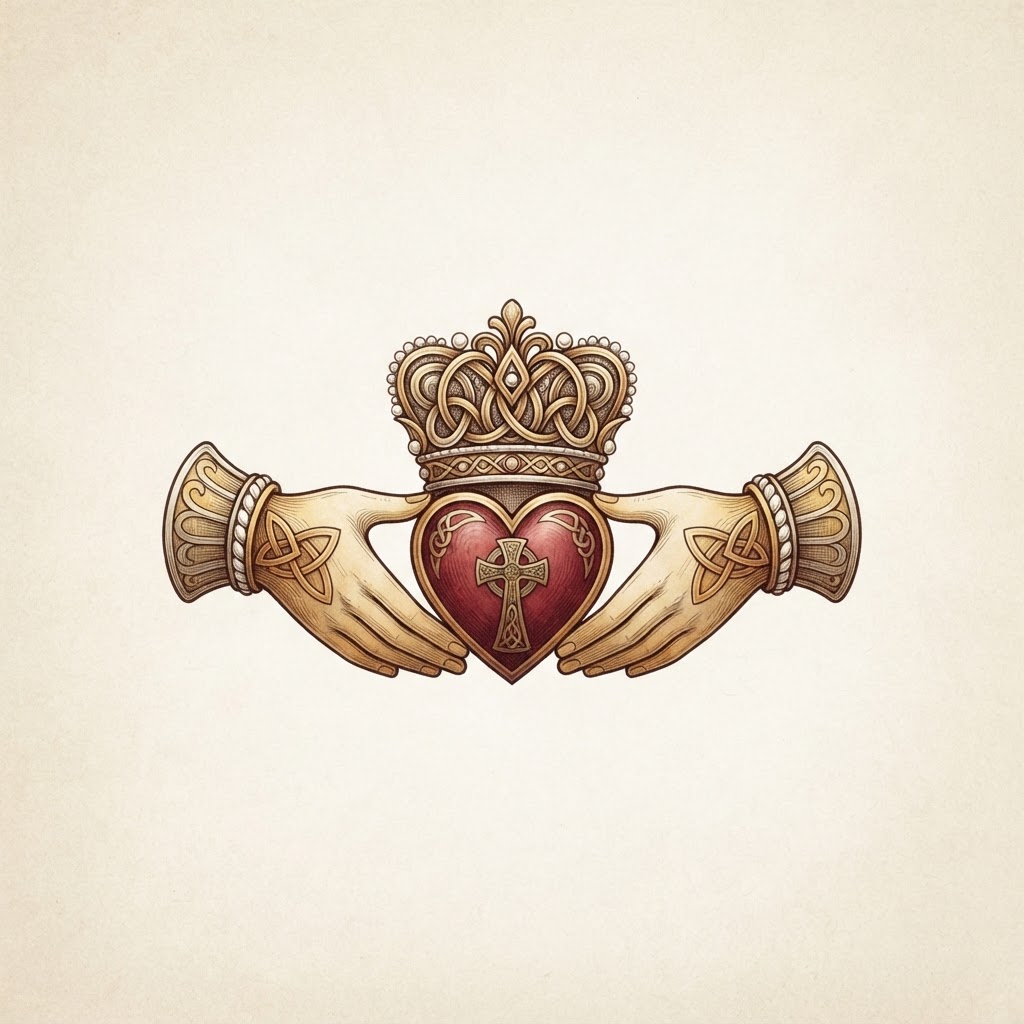
Claddagh: Meaning, Origin & Symbolism
Also known as: Claddagh Ring, Fáinne Chladaigh
Celtic
Celtic
Heart Chakra
Water
Love
Wisdom
Protection
Balance
A distinctive Irish design featuring two hands clasping a crowned heart, embodying love, friendship, and loyalty.
Quick Facts
- Category
- Celtic
- Culture / Origin
- Celtic
- Geographic Origin
- Claddagh, Galway, Ireland
- Historical Period
- Early Modern (Late 17th Century)
- Estimated Age
- circa 1690–1700 CE
- Element
- Water
- Planet
- Venus
- Chakra
- Heart
- Zodiac
- Libra, Cancer
- Deities
- Aengus Óg, Cliodhna
- Verification
- unverified
What is Claddagh?
The Claddagh is an iconic Irish design composed of three distinct figurative elements: two clasped hands holding a central heart, topped by an ornate royal crown. Hailing from the fishing village of Claddagh in Galway, this emblem is most commonly cast in gold or silver as a finger ring, passed down as an heirloom across generations.
The Claddagh belongs to the broader European tradition of 'fede' (faith) rings, which date back to Roman times, but the Galway variation uniquely synthesized the motifs of hands, heart, and crown into an enduring emblem of relationship commitments. How the ring is worn on the fingers historically signals the wearer's relationship status and intentions.
Beyond romantic devotion, the Claddagh represents an unbreakable bond of loyalty between friends, family, and homeland. It survives as one of Ireland's most beloved and widely recognized cultural symbols of enduring emotional truth.
Meaning of Claddagh
The Claddagh symbolizes love (the heart), friendship (the hands), and loyalty or fidelity (the crown).
Origin & History
The most famous historical legend traces the Claddagh ring to Richard Joyce, a Galway goldsmith who was captured by Algerian corsairs en route to the West Indies and sold into servitude under a Moorish goldsmith. Mastering the craft, Joyce was released following the accession of King William III in 1689. Returning home to Galway, he forged the first Claddagh ring for his steadfast love.
Historical examples bearing Joyce's hallmark survive from the late 17th century. The ring was embraced by the local fishing community of Claddagh as a mark of community identity, wedding pledge, and family talisman, subsequently spreading across Ireland and the Irish diaspora.
Spiritual Meaning
On an esoteric level, the Claddagh represents the trinity of emotional maturity required for healthy human relationships: supportive action (hands), unconditional empathy (heart), and elevated integrity or honor (crown). Without any one of these three attributes, harmony cannot be sustained.
It is an anchor for fidelity, reminding the wearer that true devotion requires grounded effort, genuine love, and spiritual honor between independent souls.
Symbolism
The hands symbolize companionship and cooperative action; the heart represents deep romantic and universal love; the crown denotes fidelity, sovereignty, and noble character.
Traditional Uses
Traditionally worn as a wedding or engagement ring, its orientation communicates marital status and emotional availability.
Modern Spiritual Uses
Interpreted globally as a testament to heritage, unbreakable soul connections, deep self-acceptance, and mutual honor in relationships.
Healing Associations
Applied in meditations focused on resolving heartbreak, clearing grief, and cultivating emotional trustworthiness.
Protection Associations
Worn as an amulet to protect emotional intimacy, ensure fidelity, and keep family and tribal connections safe across distances.
How the Symbol Is Used
- •Handfasting
- •Weddings
- •Devotional Vows
- •Heart Centering
Cultural Context
Celtic — Claddagh, Galway, Ireland (Early Modern (Late 17th Century))
Sources & References
- 1.Hogan, Laura. 'The Story of the Claddagh Ring.' Claddagh Press, 2002.
- 2.Hardiman, James. 'The History of the Town and County of the Town of Galway.' W. Folds and Sons, 1820.
This content is for educational and informational purposes only. Where modern spiritual interpretations are described, they are not presented as ancient historical facts. It is not a substitute for professional medical or spiritual advice.