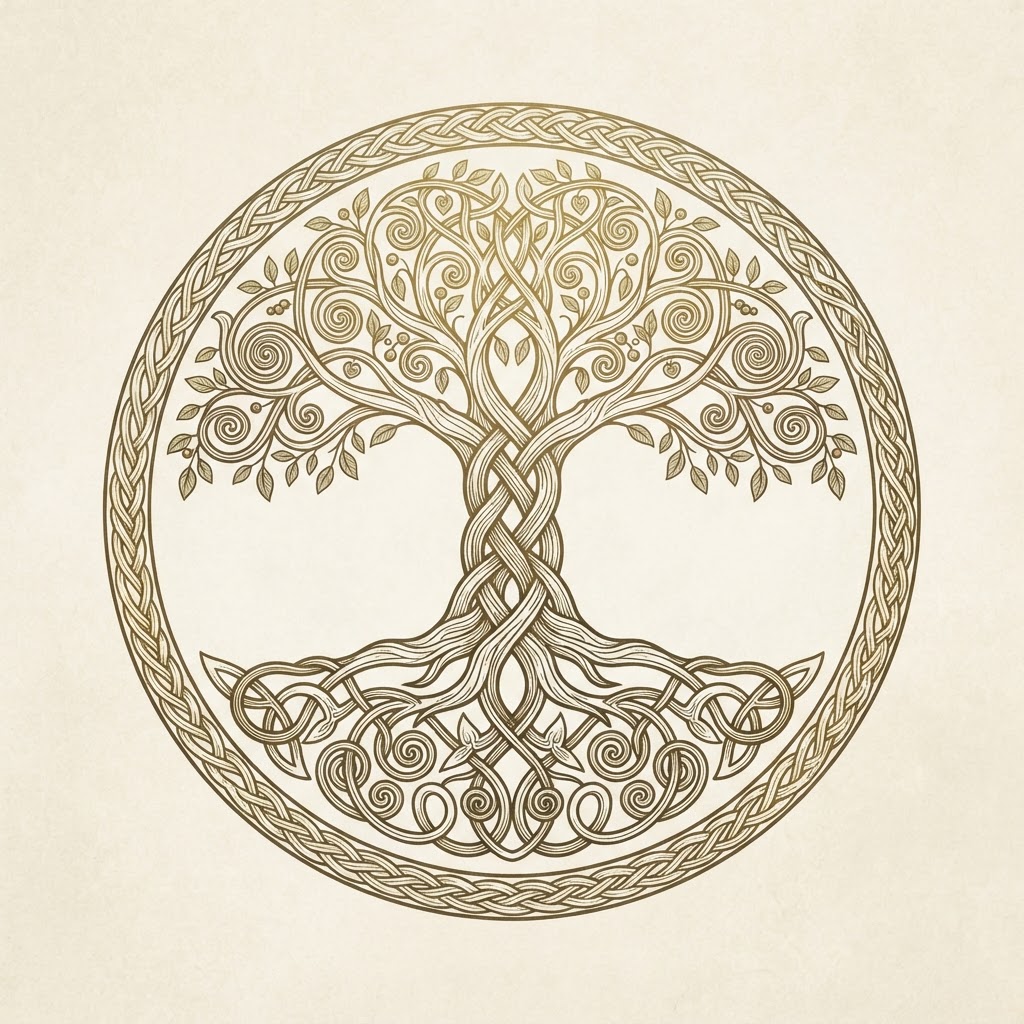
Celtic Tree of Life: Meaning, Origin & Symbolism
Also known as: Crann Bethadh
Celtic
Celtic
Root Chakra
Heart Chakra
Crown Chakra
Earth
Grounding
Growth
Wisdom
Resilience
A sacred arbor whose branches reach into heaven while its roots mirror them deep within the earth.
Quick Facts
- Category
- Celtic
- Culture / Origin
- Celtic
- Geographic Origin
- Ancient Gaul, Ireland, and Britain
- Historical Period
- Iron Age to Medieval
- Estimated Age
- 2000+ years
- Element
- Earth
- Planet
- Earth
- Chakra
- Root, Heart, Crown
- Zodiac
- Taurus, Virgo, Capricorn
- Deities
- Danu, Cernunnos, The Dagda
- Verification
- unverified
What is Celtic Tree of Life?
Crann Bethadh, or the Celtic Tree of Life, is a profound representation of the harmony and interconnectedness between all planes of existence. Represented typically with expansive, leafy branches intertwining symmetrically with an equally intricate root structure, the design forms an unbroken circular perimeter. Trees, especially the oak (Dair), were central to the Celtic cosmos, serving as protective meeting places, gateways between worlds, and living sanctuaries. The symbol honors the cyclical regeneration of the forest, the seasonal shedding and renewal of life, and the ancestral roots anchoring communities.
Meaning of Celtic Tree of Life
Cosmic axis, interconnectedness of all life, ancestral grounding, and spiritual rebirth.
Origin & History
Ancient Celts revered sacred groves (nemetons), considering magnificent solitary trees as tribal centers and sacred protectors. Enemies sought to demoralize a clan by cutting down its sacred tree. The motif gained elaborate stylistic representation in medieval knotwork art, synthesizing pagan tree veneration with the biblical Tree of Life in post-Christianization Celtic lands.
Spiritual Meaning
The Tree of Life represents the axis mundi, the pillar through which the soul ascends and descends across earthly and spirit planes. It teaches that exalted spiritual wisdom (the branches) requires deep emotional and physical grounding (the roots). By meditating on the tree, one aligns the self with the natural rhythm of decay, dormancy, and vigorous regeneration.
Symbolism
The roots signify the Otherworld, ancestral memory, and deep earthly stability; the trunk symbolizes the physical mortal world; the branches denote the celestial sphere and divine wisdom; the enclosing circle represents eternity.
Traditional Uses
Regarded as the spiritual guardian of the tribe, providing shelter, sustenance, and direct access to ancestral spirits and deities.
Modern Spiritual Uses
Widely embraced in eco-spirituality and wellness as a reminder of environmental stewardship, biological balance, and personal resilience.
Healing Associations
Grounding during energetic burnout, calming nervous exhaustion, and promoting steady physical vitality.
Protection Associations
Used to shield sanctuaries, families, and homes from discord, disaster, and spiritual disorientation.
How the Symbol Is Used
- •Nature meditation
- •Forest bathing
- •Root chakra balancing
- •Ancestral veneration
Cultural Context
Celtic — Ancient Gaul, Ireland, and Britain (Iron Age to Medieval)
Sources & References
- 1.Aldhouse-Green, Miranda. 'The Sacred World of the Celts.' Thames & Hudson, 1995.
- 2.MacCulloch, J.A. 'The Religion of the Ancient Celts.' T&T Clark, 1911.
This content is for educational and informational purposes only. Where modern spiritual interpretations are described, they are not presented as ancient historical facts. It is not a substitute for professional medical or spiritual advice.