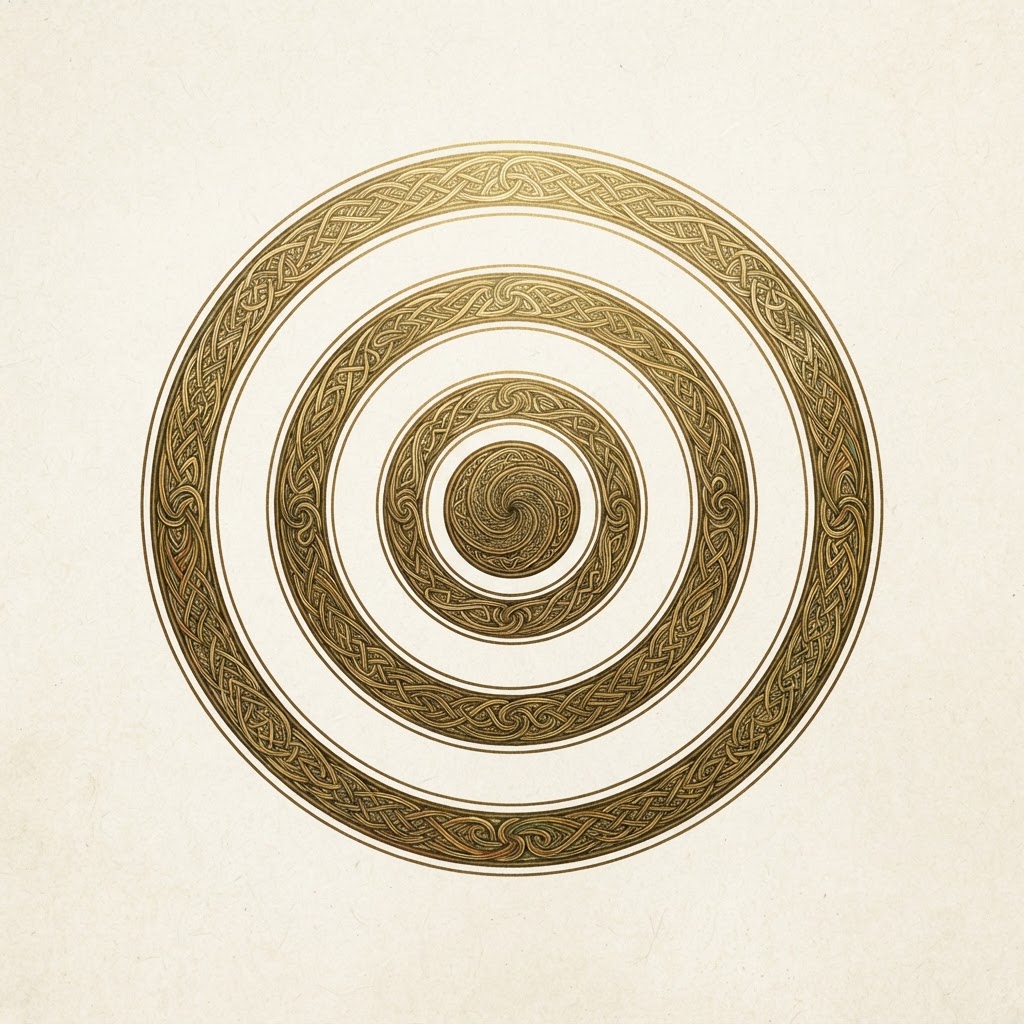
Celtic Spiral: Meaning, Origin & Symbolism
Also known as: Single Spiral, Spiral of Life
Celtic
Celtic
Sacral Chakra
Crown Chakra
Water
Transformation
Healing
Wisdom
A primordial clockwise or counterclockwise spiral representing expanding consciousness, life cycles, and cosmic energy.
Quick Facts
- Category
- Celtic
- Culture / Origin
- Celtic
- Geographic Origin
- Ireland, Scotland, and Atlantic Europe
- Historical Period
- Neolithic to Bronze/Iron Age
- Estimated Age
- circa 3500 BCE
- Element
- Water
- Planet
- Moon
- Chakra
- Sacral, Crown
- Zodiac
- Cancer, Pisces
- Deities
- Danu, Boann, Manannán mac Lir
- Verification
- unverified
What is Celtic Spiral?
The single Celtic Spiral is an elemental glyph that coils smoothly outward from a central nucleolus or inward toward a mysterious vortex. Seen across megalithic mounds, passage tombs, and later Hallstatt and La Tène bronze works, the spiral is one of the earliest aesthetic manifestations of Celtic artistic consciousness, mirroring recurring patterns in the natural world such as whirlpools, shells, fiddlehead ferns, and galactical structures.
Rather than presenting a static perimeter, the spiral is fundamentally dynamic, communicating continuous motion, expansion, and contraction. In ancient stone monuments such as Gavrinis in Brittany and Loughcrew in Ireland, concentric and solitary spirals were chiseled into dark stone chambers where sunlight entered during solstices and equinoxes.
As a foundational building block for more complex Celtic designs, the solitary spiral remains a timeless sign of life's continual journey. It charts the mysterious path inward toward spiritual revelation and the subsequent radiant expansion back into manifest reality.
Meaning of Celtic Spiral
The spiral represents the organic flow of life, cosmic expansion, and the inward and outward journey of consciousness.
Origin & History
Although universally embraced as an archetype of Celtic decoration, solitary spirals were first carved into stone passage tombs thousands of years prior to the historic Celts by Neolithic Atlantic peoples. However, when Celtic-speaking societies developed in Europe, they absorbed and refined this spiral geometry into their distinctive curvilinear La Tène style.
From the 4th century BCE onwards, spirals proliferated on bronze mirrors, personal adornments, and iron swords across Central and Western Europe, demonstrating a sustained cultural fascination with curved, undulating geometry over rigid right angles.
Spiritual Meaning
Spiritually, the inward winding spiral portrays involution—the journey into the quiet, sacred center of the self, soul searching, and the underworld of memory. The outward winding spiral represents evolution, expansion, and cosmic manifestation into active creation.
It reminds practitioners that life is not a straight, mechanical line, but an organic cycle where one periodically revisits similar experiences from higher, broader levels of awareness.
Symbolism
The winding curve represents the unwinding of time, natural growth patterns, life force energy, and the labyrinthine search for transcendent wisdom.
Traditional Uses
Historically understood as a cosmic glyph tied to solar paths, cosmological cycles, and thresholds dividing mortal life from the Otherworld.
Modern Spiritual Uses
Widely utilized in holistic healing, labyrinth walking, and meditation as an emblem of inner exploration and personal expansion.
Healing Associations
Assists with energetic unblocking, releasing trapped trauma, and harmonizing disrupted biological and spiritual rhythms.
Protection Associations
Used to dissipate stagnant or negative energy by transmuting it into dynamic, flowing movement.
How the Symbol Is Used
- •Labyrinth Meditation
- •Breathwork
- •Spiral Walks
- •Somatic Healing
Cultural Context
Celtic — Ireland, Scotland, and Atlantic Europe (Neolithic to Bronze/Iron Age)
Sources & References
- 1.Twohig, Elizabeth Shee. 'The Megalithic Art of Western Europe.' Clarendon Press, 1981.
- 2.Cunliffe, Barry. 'The Ancient Celts.' Oxford University Press, 1997.
This content is for educational and informational purposes only. Where modern spiritual interpretations are described, they are not presented as ancient historical facts. It is not a substitute for professional medical or spiritual advice.