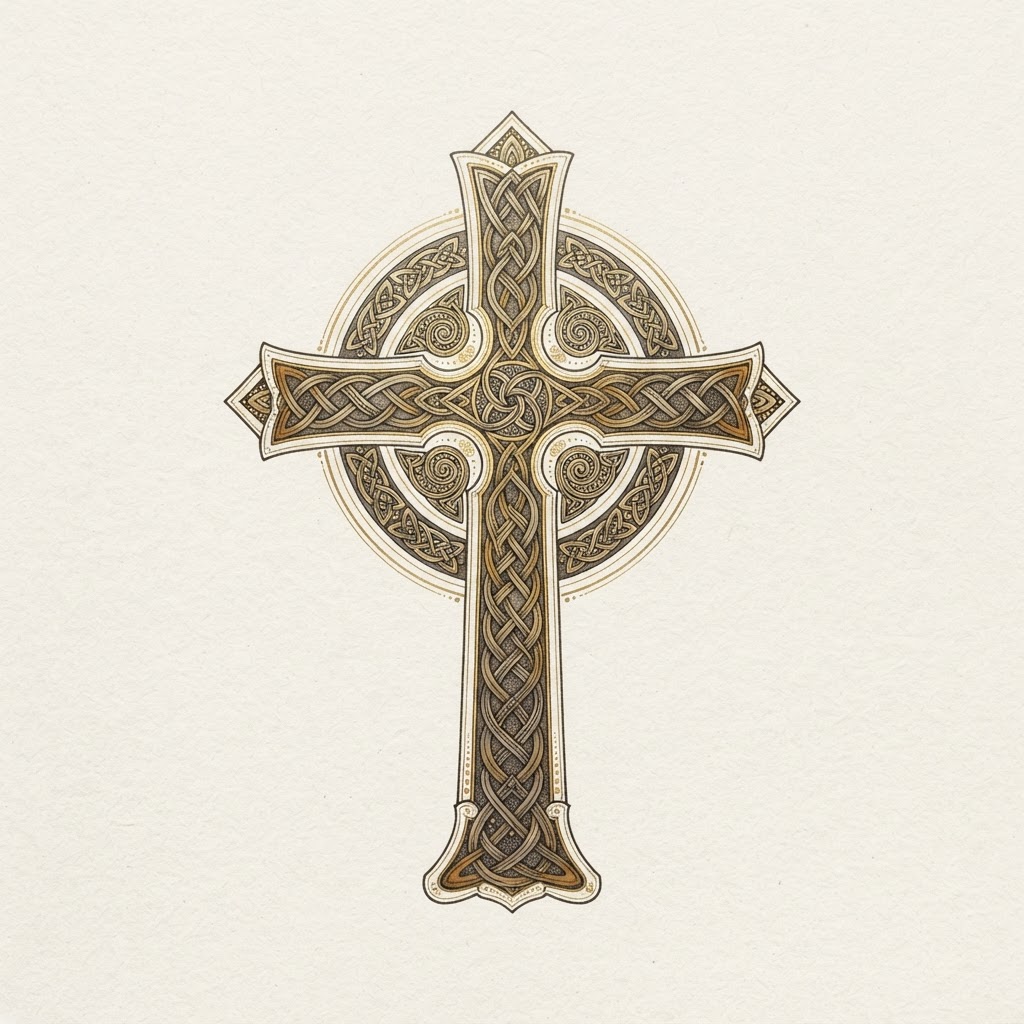
Celtic Cross: Meaning, Origin & Symbolism
Also known as: High Cross, Cross of Iona, Irish Cross
Celtic
Celtic
Root Chakra
Heart Chakra
Earth
Protection
Wisdom
Balance
Transformation
A traditional Latin cross surrounded by a nimbus or circle at the intersection, uniting celestial and earthly dimensions.
Quick Facts
- Category
- Celtic
- Culture / Origin
- Celtic
- Geographic Origin
- Ireland, Scotland, and Britain
- Historical Period
- Early Medieval
- Estimated Age
- circa 8th Century CE
- Element
- Earth
- Planet
- Sun
- Chakra
- Root, Heart
- Zodiac
- Taurus, Leo
- Deities
- Saint Patrick, Saint Columba, Brigid
- Verification
- unverified
What is Celtic Cross?
The Celtic Cross is a profound synthesis of sacred architecture and visual symbolism, consisting of an upright Christian cross enveloped at its junction by an enclosing halo or nimbus. Originating primarily as free-standing stone monuments known as High Crosses, these intricate structures served as open-air altars, boundary markers, and pedagogical tools across Ireland, Scotland, and Western Britain from the 8th to the 12th century.
Carved with remarkable precision from granite and sandstone, Celtic Crosses feature elaborate panels illustrating biblical narratives, intertwined zoomorphic beasts, spiral geometries, and boundless interlaced knots. The presence of the circle not only reinforced the fragile structural integrity of the stone arms but also anchored deeply rooted cultural reverence for the sun, seasons, and cosmic spheres.
In the modern era, the Celtic Cross stands as a quintessential emblem of Irish and Scottish identity. It carries an aura of ancient sanctity and solemn beauty, bridging the primal forces of earthly nature with elevated spiritual communion.
Meaning of Celtic Cross
The Celtic Cross represents the harmonious integration of divine transcendence with earthly reality, emphasized by the unending circle of celestial light.
Origin & History
Monastic communities such as those at Iona, Clonmacnoise, and Monasterboice pioneered the construction of monumental High Crosses during the early Middle Ages. Legends attribute the cross to Saint Patrick, who supposedly combined the Christian cross with the sun-disk to convey the message of divine light to newly converted Celtic pagans, though historians regard this as a later foundation myth.
The cross evolved structurally from wooden and flat slab prototypes into towering stone monuments up to seven meters tall. Following the 19th-century Celtic Revival, the design transitioned into common use on cemetery memorials, jewelry, and ecclesiastical heraldry worldwide.
Spiritual Meaning
The four arms extending past the circle symbolize the four cardinal directions, elements, and seasons, anchoring spiritual energy deeply into the physical sphere. The encircling halo signifies eternity, the infinite source, and divine wholeness encircling human limitation.
For contemporary spiritual seekers, the cross is a profound compass of balance. The intersection marks the eternal present moment—the still axis where heaven touches earth, where mortal and immortal consciousness converge in unified stillness.
Symbolism
The vertical shaft represents the axis mundi connecting spirit and material realms, the horizontal crossbar indicates earthly existence, and the intersecting circle represents cosmic unity and the cyclical sun.
Traditional Uses
Within Insular Christianity, it symbolizes the triumph of Christ and resurrection, surrounded by the radiant corona of eternal divine glory.
Modern Spiritual Uses
Modern seekers view it as an emblem of holistic balance, honoring ancestral roots, the seasons, and personal inner alignment.
Healing Associations
Utilized as a visual focal point for restoring spiritual centering, easing grief, and resolving internal polarities.
Protection Associations
Regularly placed at crossroads, churchyards, and boundaries to establish sanctified ground and deflect negative intrusions.
How the Symbol Is Used
- •Prayer
- •Pilgrimage
- •Ancestral Honoring
- •Grounding Rituals
Cultural Context
Celtic — Ireland, Scotland, and Britain (Early Medieval)
Sources & References
- 1.Harbison, Peter. 'The High Crosses of Ireland.' Habelt, 1992.
- 2.Richardson, Hilary, and John Scarry. 'An Introduction to Irish High Crosses.' Mercier Press, 1990.
This content is for educational and informational purposes only. Where modern spiritual interpretations are described, they are not presented as ancient historical facts. It is not a substitute for professional medical or spiritual advice.