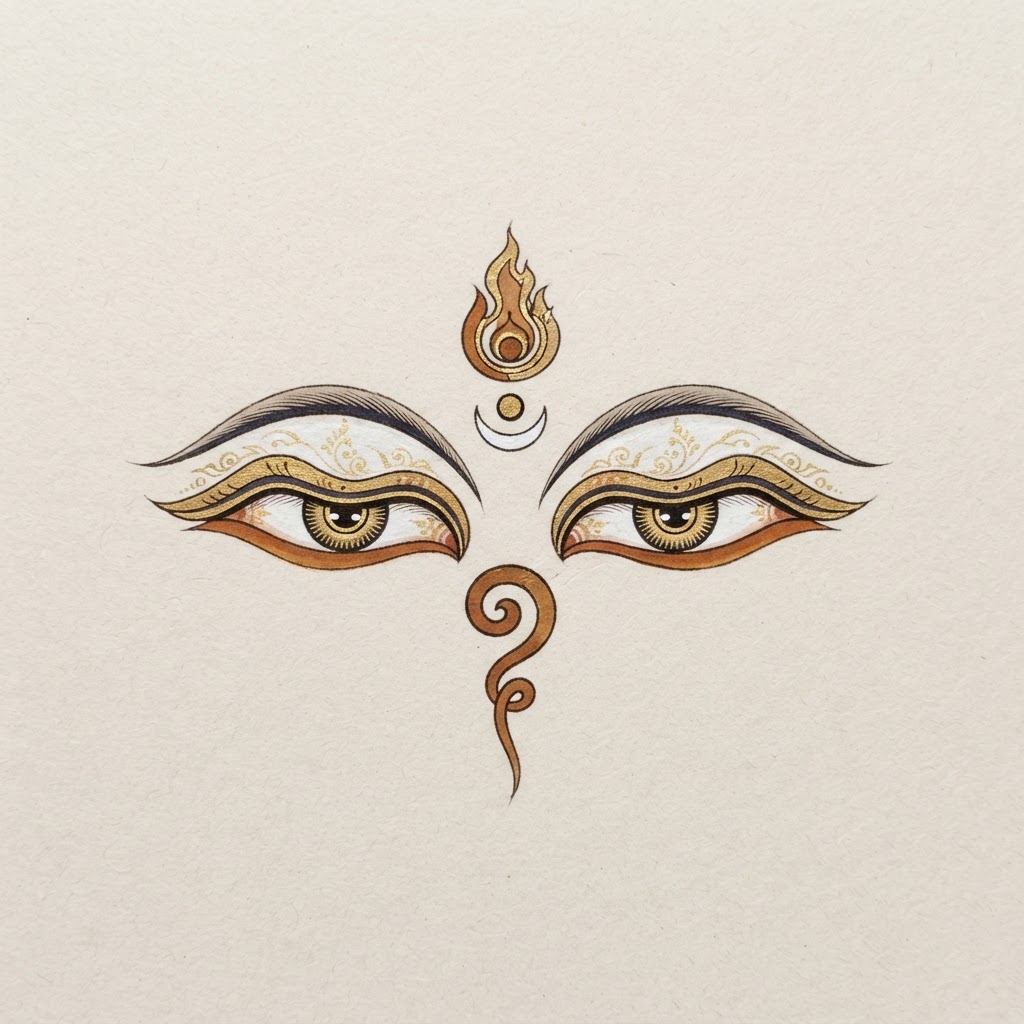
Buddha's Eyes: Meaning, Origin & Symbolism
Also known as: Wisdom Eyes, Eyes of the Buddha, Eyes of the Stupa
Buddhist
Buddhist
Third Eye Chakra
Air
Wisdom
Protection
Clarity
Compassion
The omnipresent, compassionate gaze painted on Nepalese stupas, signifying all-seeing spiritual wisdom and universal unity.
Quick Facts
- Category
- Buddhist
- Culture / Origin
- Buddhist
- Geographic Origin
- Nepal (Himalayan Buddhism)
- Historical Period
- Early Medieval
- Estimated Age
- circa 5th century CE
- Element
- Air
- Planet
- Jupiter
- Chakra
- Third Eye
- Deities
- Adi-Buddha, Vairochana
- Verification
- unverified
What is Buddha's Eyes?
Buddha's Eyes, also widely known as Wisdom Eyes, are iconic features painted on all four sides of Buddhist stupas across Nepal, most famously at Swayambhunath and Boudhanath. Facing the cardinal directions, these stylized eyes gaze outward over the surrounding landscape, conveying the omniscient and compassionate presence of the awakened mind looking across the cosmos.
Between the eyes sits the Urna, a swirl or dot indicating the third eye of transcendent spiritual vision. Below the eyes, where a nose would typically appear, is a curious curly glyph representing the Devanagari numeral one ('१'). This numeral emphasizes that the ultimate path to cessation of suffering is singular, while also celebrating the unified, indivisible nature of reality.
Meaning of Buddha's Eyes
The symbol represents the all-seeing, compassionate wisdom of the awakened mind perceiving the true nature of reality across all directions.
Origin & History
Originating in the Kathmandu Valley during the Licchavi and Malla dynasties, this visual motif developed alongside distinctive Newar Buddhist architectural traditions. As stupas evolved from simple reliquary mounds into complex architectural representations of the cosmic mandala, the eyes were placed upon the Harmika (the square tower crowning the dome) to signify the Buddha overseeing the four quarters of the universe.
Spiritual Meaning
Buddha's Eyes signify that nothing escapes the purview of karmic cause and effect or the compassionate sight of the enlightened. The eyes embody both Karuna (universal compassion) and Prajna (transcendent wisdom), watching without judgment.
Symbolism
The twin open eyes denote everyday awareness and wisdom; the curly nose represents the numeral one, pointing to non-duality; and the third eye above indicates awakening beyond sensory perception.
Traditional Uses
Traditionally, the eyes remind devotees circumambulating the stupa that the Buddha's omniscient awareness is ever-present, guiding practitioners toward liberation.
Modern Spiritual Uses
Modern viewers interpret the eyes as a serene reminder of constant mindfulness, introspective self-inquiry, and viewing the world through a lens of unconditional acceptance.
Healing Associations
Relieves feelings of isolation and brings comfort through the experience of being held in universal compassion.
Protection Associations
Protects communities from negative spiritual influences and calms territorial disputes.
How the Symbol Is Used
- •Stupa circumambulation (Kora)
- •Trataka (gazing meditation)
- •Mindfulness meditation
- •Devotional prayer
Cultural Context
Buddhist — Nepal (Himalayan Buddhism) (Early Medieval)
Sources & References
- 1.The Stupa: Sacred Symbol of Enlightenment by Tarthang Tulku
- 2.Buddhist Iconography by Lokesh Chandra
- 3.The Handbook of Tibetan Buddhist Symbols by Robert Beer
This content is for educational and informational purposes only. Where modern spiritual interpretations are described, they are not presented as ancient historical facts. It is not a substitute for professional medical or spiritual advice.