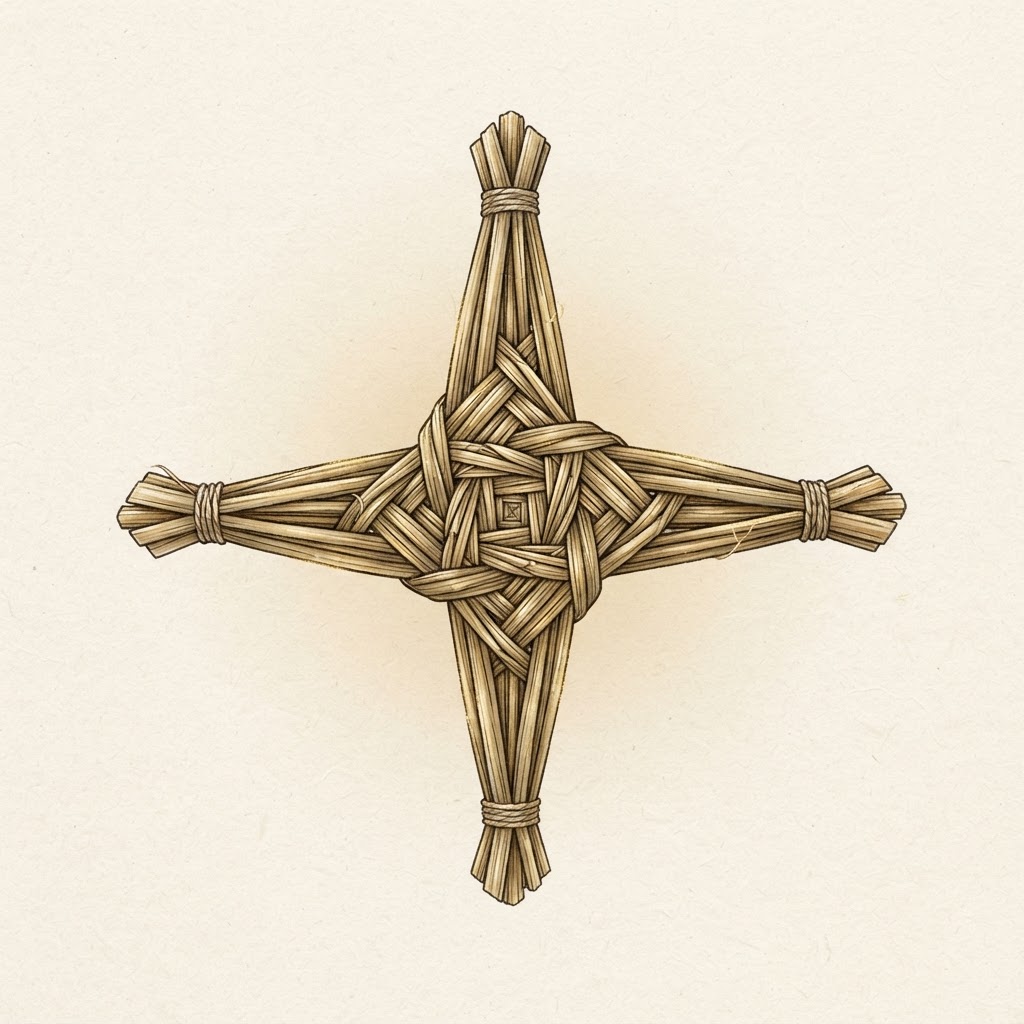
Brigid's Cross: Meaning, Origin & Symbolism
Also known as: Cros Bríde, Brighid's Cross, St. Brigid's Cross
Celtic
Celtic
Heart Chakra
Solar Plexus Chakra
Fire
Protection
Healing
Love
Transformation
A distinctive woven cross made of rushes or straw, traditionally crafted on Imbolc to protect the home from fire and misfortune.
Quick Facts
- Category
- Celtic
- Culture / Origin
- Celtic
- Geographic Origin
- Ireland
- Historical Period
- Early Christian to Early Modern (Folk Tradition)
- Estimated Age
- circa 5th–7th Century CE (with pre-Christian roots)
- Element
- Fire
- Planet
- Sun
- Chakra
- Heart, Solar Plexus
- Zodiac
- Aquarius, Aries
- Deities
- Brigid, Saint Brigid
- Verification
- unverified
What is Brigid's Cross?
Brigid's Cross is a traditional Irish folk symbol characterized by four arms radiating counterclockwise from a tightly woven square center, though three-armed variations historically existed in parts of rural Ireland. Handwoven from fresh rushes, reeds, or wheat straw, the cross is intrinsically tied to the festival of Imbolc and the feast day of Saint Brigid of Kildare on February 1st.
Unlike aristocratic stone carvings or illuminated manuscripts, Brigid's Cross is an authentic folk tradition created directly by domestic households. The materials are harvested directly from the natural landscape, connecting the maker directly to the earth at the subtle turning point between winter and early spring.
Once woven, the cross is hung over doorways, in rafters, and in barns throughout the year. Its physical decay mirrors the passage of the seasons, after which it is traditionally burned and replaced each spring, maintaining a living bridge between ancestral domestic lore and agrarian devotion.
Meaning of Brigid's Cross
Brigid's Cross is a protective household talisman woven to safeguard families and livestock from fire, famine, and sickness.
Origin & History
According to oral tradition and hagiography, Saint Brigid sat beside the deathbed of a pagan chieftain (often remembered as her father). As she tended to him, she gathered rushes from the floor and wove them into a cross, explaining the message of Christ's salvation, leading to his conversion before death.
Scholars recognize that this lore overlies pre-Christian solar customs surrounding the Celtic goddess Brigid—associated with fertility, blacksmithing, poetry, and sacred hearth fires. The four-armed rotating appearance reflects traditional solar wheels that celebrated the renewal of life during early spring.
Spiritual Meaning
At a spiritual level, Brigid's Cross heralds the return of warmth, vitality, and solar renewal after the dormancy of winter. It honors the divine feminine principle of nurturing stewardship, hospitality, and life-giving creativity.
The act of plaiting rushes is itself a meditative rite, blending natural elements with conscious intent. It represents protection drawn not from aggressive force, but from sacred shelter, domestic peace, and harmonious communion with natural rhythms.
Symbolism
The woven square center signifies the protected hearth and earth, while the radiating arms represent the four directions, the four seasonal festivals, and the sun's turning light.
Traditional Uses
Hung in Irish homes to invoke Saint Brigid's blessings, protect against structure fires, illness, and preserve the family's livestock and food supplies.
Modern Spiritual Uses
Cherished by modern pagans and cultural practitioners as an emblem of Imbolc, feminine power, home sanctification, and environmental renewal.
Healing Associations
Associated with childbirth protection, domestic harmony, and easing creative and emotional stagnation.
Protection Associations
Hung above entryways to prevent structural fires, illness, lightning strikes, and negative spirits from crossing the threshold.
How the Symbol Is Used
- •Imbolc Celebrations
- •Threshold Magic
- •Folk Crafting
- •House Blessings
Cultural Context
Celtic — Ireland (Early Christian to Early Modern (Folk Tradition))
Sources & References
- 1.Danaher, Kevin. 'The Year in Ireland: Irish Calendar Customs.' Mercier Press, 1972.
- 2.Ó Catháin, Séamas. 'The Festival of Brigit: Celtic Goddess and Holy Woman.' DBA Publications, 1995.
This content is for educational and informational purposes only. Where modern spiritual interpretations are described, they are not presented as ancient historical facts. It is not a substitute for professional medical or spiritual advice.