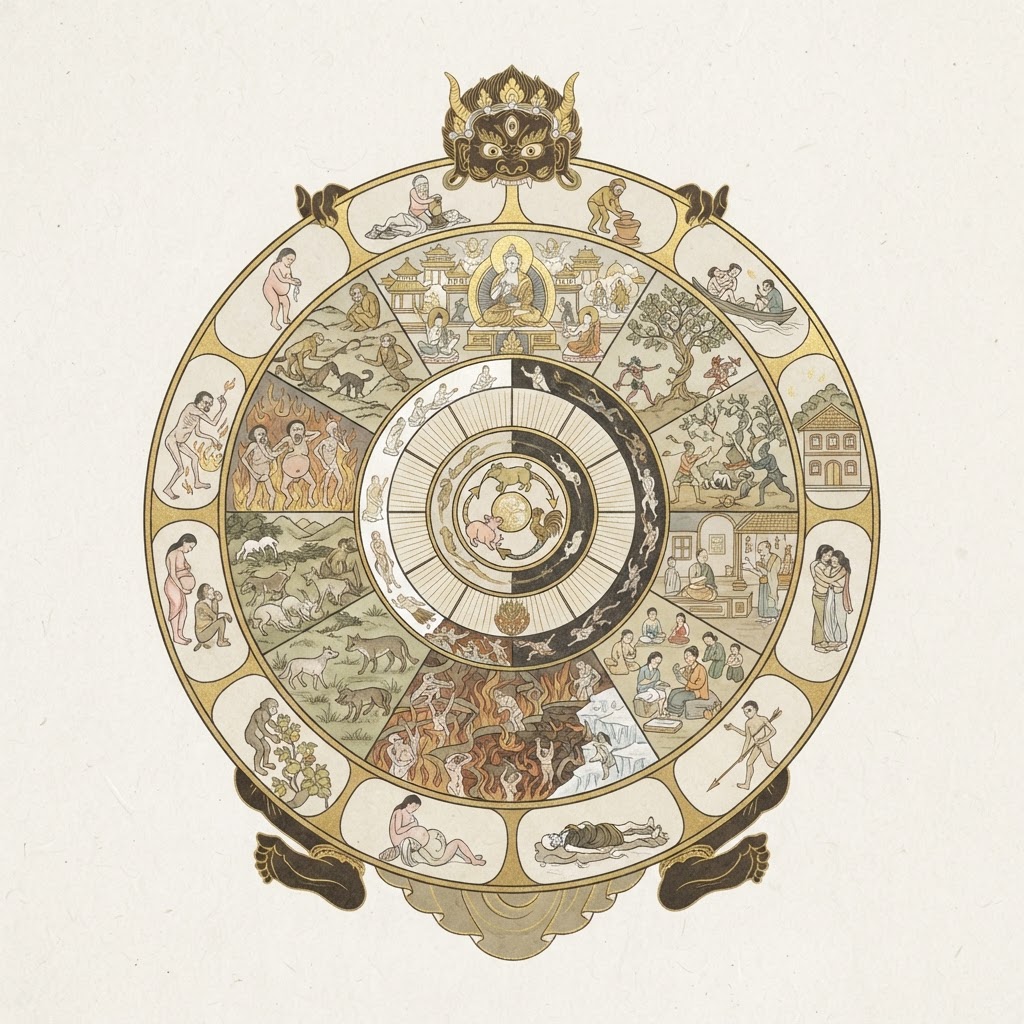
Bhavacakra: Meaning, Origin & Symbolism
Also known as: Wheel of Life, Wheel of Becoming, Samsara Wheel
Buddhist
Buddhist
Root Chakra
Solar Plexus Chakra
Earth
Wisdom
Transformation
Clarity
A profound visual diagram detailing the psychological mechanisms of rebirth, karmic cause, and the realms of existence.
Quick Facts
- Category
- Buddhist
- Culture / Origin
- Buddhist
- Geographic Origin
- Ancient India
- Historical Period
- Classical Antiquity
- Estimated Age
- circa 3rd century BCE
- Element
- Earth
- Planet
- Saturn
- Chakra
- Root, Solar Plexus
- Deities
- Yama, Gautama Buddha
- Verification
- unverified
What is Bhavacakra?
The Bhavacakra, commonly translated as the Wheel of Life or Wheel of Becoming, is a complex didactic artwork painted on the outer entry walls of Tibetan Buddhist monasteries. Unlike purely abstract symbols, the Bhavacakra is an intricate cosmological map designed to guide both monastic practitioners and illiterate lay pilgrims through the realities of cyclic existence (samsara). Held firmly in the jaws, hands, and feet of Yama, the fearsome demon of impermanence and death, the wheel illustrates the psychological and cosmological forces that perpetuate suffering. By illustrating the inner machinery of delusion and karma, the diagram directly instructs viewers on how to dismantle their suffering through understanding and mindful detachment.
Meaning of Bhavacakra
The cyclical nature of rebirth driven by karma, desire, and mental defilement, bounded by impermanence.
Origin & History
According to the Divyavadana (a collection of Buddhist tales), the Buddha himself drafted the outline of the Bhavacakra using grains of rice and instructed Maudgalyayana to depict it at temple entrances to instruct pilgrims on cause and effect.
Spiritual Meaning
The Bhavacakra serves as a stark mirror for the human condition. It reveals that our reality is formed by internal mental attitudes, showing how negative emotional poisons generate cyclic suffering while also indicating that liberation lies outside the wheel in the figure of the pointing Buddha.
Symbolism
At the hub, a pig, snake, and rooster symbolize ignorance, aversion, and greed. The inner ring depicts good and bad karma. The broad middle sections represent the Six Realms of Existence, and the outer rim illustrates the Twelve Links of Dependent Origination.
Traditional Uses
Traditionally used as an educational meditation device to cultivate revulsion for samsara (samvega) and generate an urgent longing for liberation.
Modern Spiritual Uses
Modern psychologists and mindfulness therapists analyze the wheel as an accurate framework for understanding addiction cycles, conditioned emotional reactions, and trauma loops.
Healing Associations
Helps overcome unconscious behavioral loops, processing existential fears and accepting mortality.
Protection Associations
Shields practitioners against complacency, delusion, and reckless karmic deeds through moral vigilance.
How the Symbol Is Used
- •Analytical Meditation
- •Monastic Teaching
- •Contemplation of Impermanence
Cultural Context
Buddhist — Ancient India (Classical Antiquity)
Sources & References
- 1.The Tibetan Wheel of Life by Lati Rinpoche
- 2.Introduction to Tibetan Buddhism by John Powers
This content is for educational and informational purposes only. Where modern spiritual interpretations are described, they are not presented as ancient historical facts. It is not a substitute for professional medical or spiritual advice.