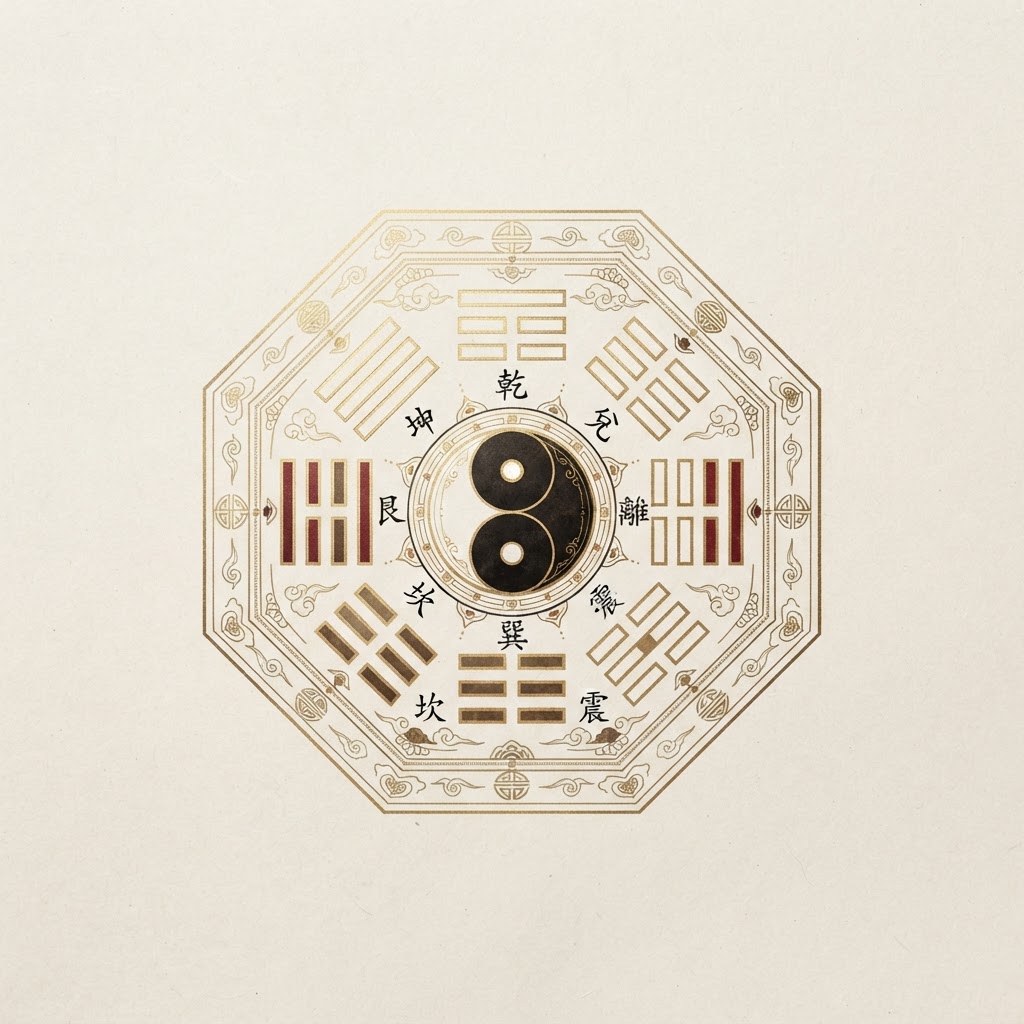
Bagua: Meaning, Origin & Symbolism
Also known as: Eight Trigrams, Pa Kua
Taoist/Chinese
Taoist/Chinese
Third Eye Chakra
Crown Chakra
Ether/Spirit
Wisdom
Protection
Harmony
Balance
An octagonal cosmological arrangement of eight trigrams representing the fundamental principles of reality and cyclic change.
Quick Facts
- Category
- Taoist/Chinese
- Culture / Origin
- Taoist/Chinese
- Geographic Origin
- China
- Historical Period
- Neolithic to Zhou Dynasty
- Estimated Age
- 3000+ years
- Element
- Ether/Spirit
- Chakra
- Third Eye, Crown
- Deities
- Fu Xi, King Wen
- Verification
- unverified
What is Bagua?
The Bagua, or Eight Trigrams, is a foundational matrix of Chinese cosmology, divination, and Taoist ritual. Composed of eight distinct symbols—each consisting of three stacked lines that are either solid (Yang) or broken (Yin)—the Bagua represents the myriad combinations of fundamental elemental and energetic forces operating in nature and human experience.
The eight trigrams are Qian (Heaven), Kun (Earth), Zhen (Thunder), Xun (Wind), Kan (Water), Li (Fire), Gen (Mountain), and Dui (Lake). Arranged in circular configurations, the Bagua demonstrates how cosmic energies interact, mutate, and sustain the material world. The two primary arrangements are the Xian Tian Bagua (Earlier Heaven, symbolizing primordial, ideal balance) and the Hou Tian Bagua (Later Heaven, symbolizing temporal, manifested reality).
In practical application, the Bagua serves as the fundamental compass for Feng Shui analysis, martial arts movement patterns, and internal cultivation. When combined into pairs, the eight trigrams yield the 64 hexagrams of the classic divination text, the I Ching.
Meaning of Bagua
The Bagua represents the eight fundamental energetic archetypes and elemental phases through which the universe continuously cycles and manifests.
Origin & History
Mythological tradition attributes the discovery of the Bagua to the legendary sage-ruler Fu Xi, who reportedly discerned the eight trigrams inscribed upon the back of a mythical dragon-horse emerging from the Yellow River. Historically, trigram divination emerged out of ancient turtle shell and yarrow stalk pyromancy during the Shang and early Zhou dynasties.
King Wen and the Duke of Zhou systematically codified these trigrams into the 64 hexagrams of the I Ching around 1000 BCE. By the Han Dynasty, the Bagua had been thoroughly integrated into five-element theory, astronomical calculations, and Taoist religious liturgies, establishing itself as the structural blueprint of the universe.
Spiritual Meaning
Spiritually, the Bagua is a map of consciousness and cosmic manifestation. In Earlier Heaven formation, it represents the timeless, perfect harmony of the universe prior to physical birth and dissolution. In Later Heaven formation, it maps the temporal life of human beings, illustrating the cyclical nature of time, seasons, emotions, and worldly interactions.
By contemplating the Bagua, a Taoist adept learns to observe the rising and falling of energies in external circumstances and internal states. It reveals that no situation is static; every condition inherently contains the mechanics of its own transformation into the next phase.
Symbolism
Each trigram is constructed from unbroken lines representing pure Yang energy and broken lines representing pure Yin energy. The eight arrangements correspond to specific elements, cardinal directions, family roles, bodily organs, and seasons, forming an all-encompassing holographic model of the macrocosm and microcosm.
Traditional Uses
Traditionally, the Bagua is the core tool of the I Ching and Feng Shui. It is employed to diagnose spatial, personal, and geopolitical fortunes, identify energetic imbalances in living environments, and chart spiritual destiny.
Modern Spiritual Uses
In modern spiritual and interior design practices, the Bagua is used as an energy template superimposed over homes and workspaces to enhance abundance, health, relationships, and personal growth.
Healing Associations
Correlates directly with the meridian system and five-organ network in Traditional Chinese Medicine to diagnose and resolve systemic disharmony.
Protection Associations
Bagua mirrors (concave and convex) are hung outside dwellings in Feng Shui to deflect Sha Qi (harmful spiritual energy) and ward off malevolent entities.
How the Symbol Is Used
- •I Ching Divination
- •Feng Shui
- •Baguazhang Martial Arts
- •Neidan Meditation
Cultural Context
Taoist/Chinese — China (Neolithic to Zhou Dynasty)
Sources & References
- 1.Wilhelm, Richard. 'The I Ching or Book of Changes' (1950)
- 2.Skinner, Stephen. 'The Living Earth Manual of Feng-Shui' (1989)
- 3.Saso, Michael. 'Taoism and the Rite of Cosmic Renewal' (1990)
This content is for educational and informational purposes only. Where modern spiritual interpretations are described, they are not presented as ancient historical facts. It is not a substitute for professional medical or spiritual advice.