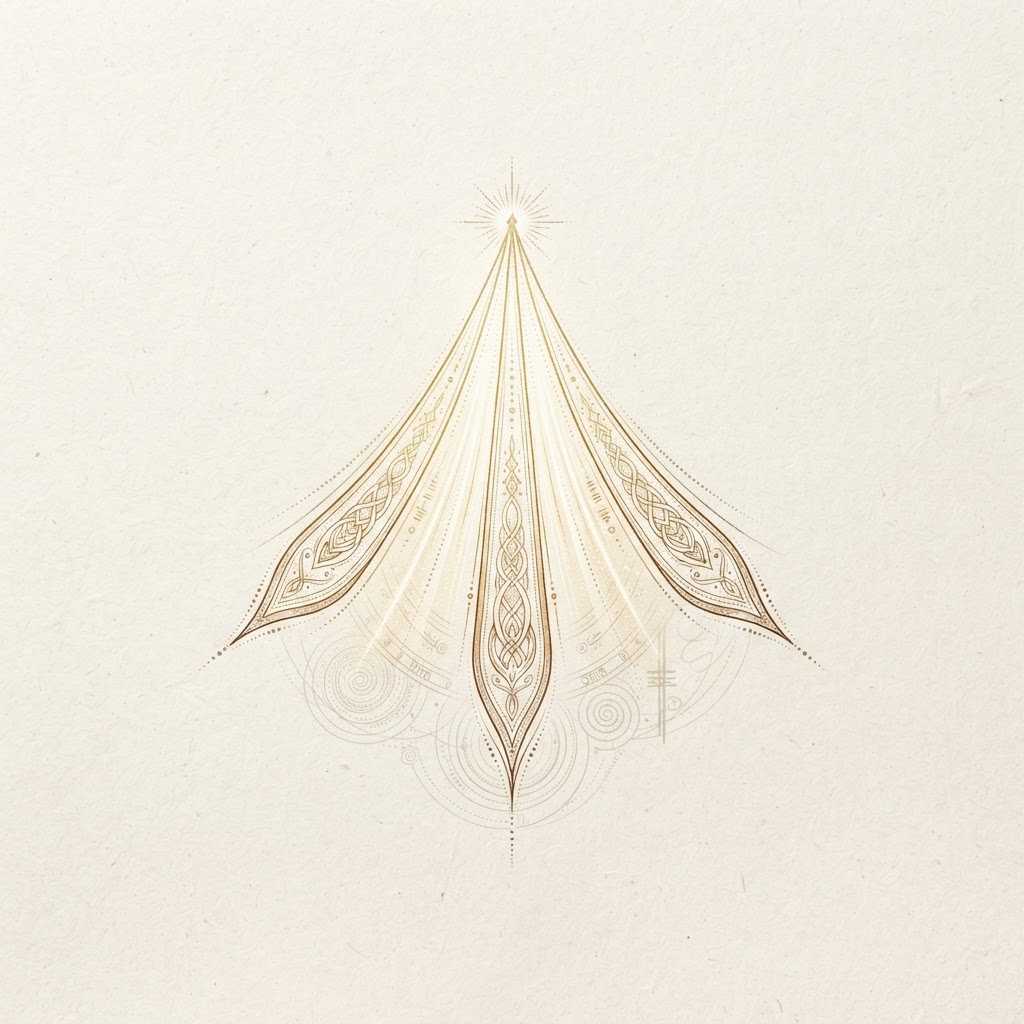
Awen: Meaning, Origin & Symbolism
Also known as: The Three Rays, Awen of the Bards
Celtic
Celtic
Throat Chakra
Third Eye Chakra
Crown Chakra
Air
Creativity
Wisdom
Inspiration
Truth
A triad of downward-radiating light rays representing divine inspiration, illumination, and truth.
Quick Facts
- Category
- Celtic
- Culture / Origin
- Celtic
- Geographic Origin
- Wales
- Historical Period
- Late 18th Century Revival with Early Medieval linguistic roots
- Estimated Age
- circa 1792 CE (visual emblem)
- Element
- Air
- Planet
- Mercury
- Chakra
- Throat, Third Eye, Crown
- Zodiac
- Gemini, Aquarius
- Deities
- Taliesin, Ceridwen, Brighid
- Verification
- unverified
What is Awen?
The Awen is an emblematic symbol of Welsh and broader Celtic inspiration, visually rendered as three descending rays of light terminating in or framed by three points, often enclosed within three concentric circles. The Welsh word 'awen' translates directly to 'poetic inspiration', 'flowing spirit', or 'genius'. While rooted in early medieval Welsh literature, the graphic emblem was developed during the 18th-century Celtic and Druidic Revival by visionary scholar Iolo Morganwg. It encapsulates the flash of divine creative epiphany that strikes the poet, musician, seer, and philosopher.
Meaning of Awen
Divine inspiration, the pursuit of truth, and flowing creative revelation.
Origin & History
The word appears in the 9th-century 'Historia Brittonum' and the poetry of Taliesin to describe ecstatic divine breath illuminating the poet. In the late 1700s, Edward Williams (Iolo Morganwg) designed the three-rayed glyph for his Gorsedd of Bards, synthesizing older bardic lore into an iconic emblem that remains the central symbol of modern Druidry.
Spiritual Meaning
The Awen captures the grace of divine consciousness flowing into human expression. It represents the creative spark that awakens deep wisdom in the mind. It encourages living in complete resonance with truth, understanding that artistic and spiritual insights are gifts channeled from the cosmic source.
Symbolism
The outer rays represent the active masculine and receptive feminine polarities, while the central ray represents their harmonious balance. They also signify the three orders of Bard, Ovate, and Druid, and the primal sounds of divine creation.
Traditional Uses
Historically understood in Welsh poetry as the ecstatic, divine gift that turns ordinary speech into prophetic, timeless poetry.
Modern Spiritual Uses
The premier symbol of modern Druidic and pagan practices, representing creative flow, artistic breakthrough, and harmony with nature.
Healing Associations
Assists with clearing throat chakra blocks, creative paralysis, and intellectual exhaustion.
Protection Associations
Protects the authentic creative voice from fear of judgment and artistic stagnation.
How the Symbol Is Used
- •Chanting the Awen
- •Bardic poetry
- •Druidic rituals
- •Creative writing invocations
Cultural Context
Celtic — Wales (Late 18th Century Revival with Early Medieval linguistic roots)
Sources & References
- 1.Morganwg, Iolo. 'The Barddas.' Longman, 1862.
- 2.Hutton, Ronald. 'The Druids: A History.' Hambledon Continuum, 2007.
This content is for educational and informational purposes only. Where modern spiritual interpretations are described, they are not presented as ancient historical facts. It is not a substitute for professional medical or spiritual advice.