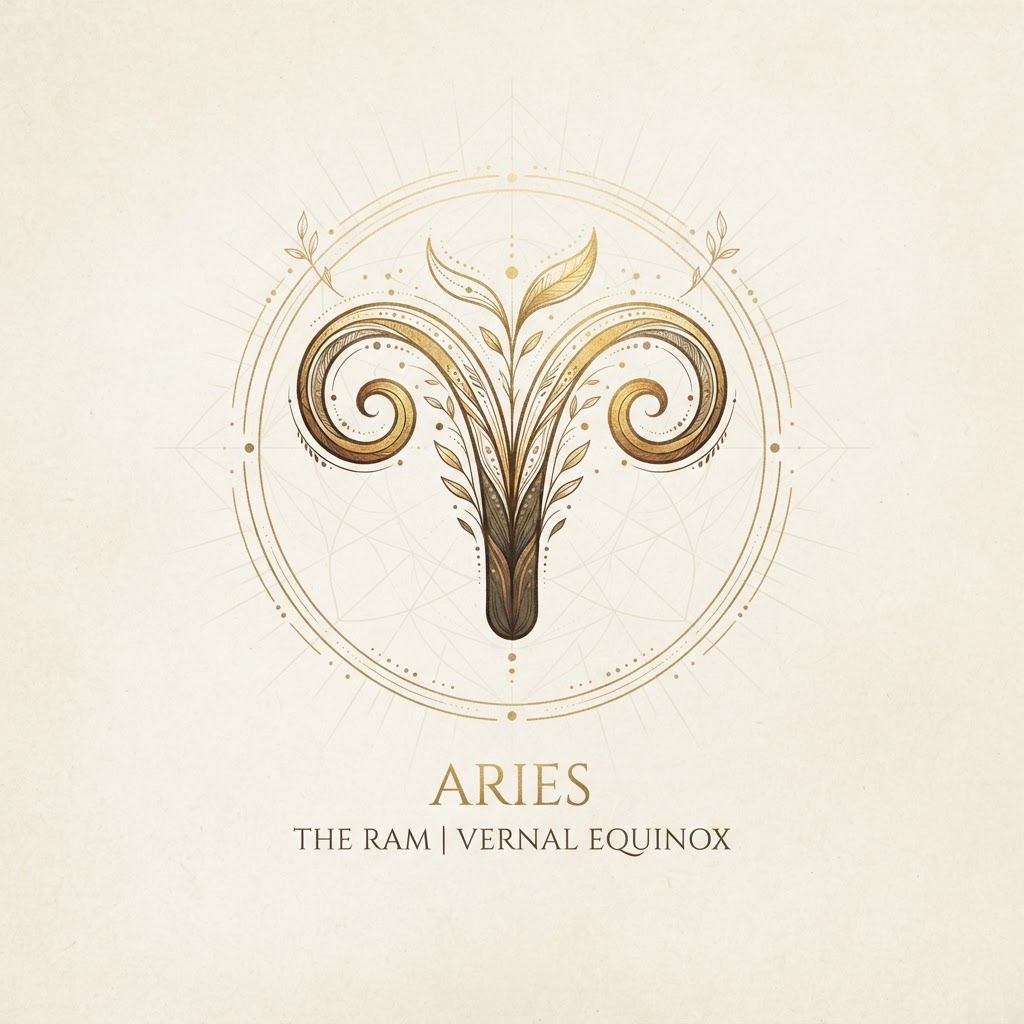
Aries Glyph: Meaning, Origin & Symbolism
Also known as: The Ram, Sign of the Ram, Aries Symbol
Zodiac
Babylonian and Hellenistic
Solar Plexus Chakra
Third Eye Chakra
Fire
Courage
Initiation
Transformation
Vitality
The Aries glyph represents the curved horns of the Ram and the emerging sprout of new life at the vernal equinox.
Quick Facts
- Category
- Zodiac
- Culture / Origin
- Babylonian and Hellenistic
- Geographic Origin
- Mesopotamia and Mediterranean
- Historical Period
- Classical Antiquity
- Estimated Age
- circa 2000 BCE
- Element
- Fire
- Planet
- Mars
- Chakra
- Solar Plexus, Third Eye
- Zodiac
- Aries
- Deities
- Ares, Mars, Athena, Agni
- Verification
- unverified
What is Aries Glyph?
The Aries glyph is visually depicted as two outward-curving horns springing from a central stem, traditionally resembling the horns of a charging ram. Cosmologically, it marks the zero-point of the tropical zodiac, initiating the cycle of astrological manifestation. It symbolizes primal life force, dynamic emergence, and the spark of consciousness breaking through inertia.
Historically linked to the Mesopotamian agrarian calendar and later systematized in Greco-Roman astrology, the symbol captures the unrestrained vital energy of spring. It represents the courage to pioneer, initiate, and declare individual existence in the material plane.
Meaning of Aries Glyph
The Aries glyph symbolizes initiation, pioneering action, leadership, and the primal impulse of life emerging from potential.
Origin & History
In ancient Babylonian astronomy, this constellation was recorded in the MUL.APIN tables as the Agrarian Worker or Hired Man (LÚ.ḪUN.GÁ), later closely associated with Dumuzi the shepherd and represented as a ram. With the development of the mathematical zodiac in the first millennium BCE, Hellenistic astrologers adopted the symbol to represent the cardinal fire sign initiating the astrological year at the vernal equinox.
Classical myth associated the constellation with Chrysomallos, the winged golden-fleeced ram that rescued Phrixus and Helle in Greek mythology, whose fleece became the object of Jason and the Argonauts' quest.
Spiritual Meaning
Spiritually, the glyph embodies the divine spark of individualization—the 'I Am' presence descending into material embodiment. It represents the creative spiritual fire that shatters boundaries to birth new forms of consciousness.
It is viewed as a reminder of inner willpower and the divine drive to overcome obstacles through spiritual courage and unwavering determination.
Symbolism
The branching horns represent the bifurcation of energy springing upward from a singular point, mirroring a sprouting seed breaking through soil, the eyebrows and nose bridge of the human face (seat of perception), and the defensive yet forward-charging horns of the ram.
Traditional Uses
Traditionally, Aries is governed by Mars and denotes cardinal heat and dryness. Medieval and Renaissance astrologers associated it with warriors, pioneers, swift action, assertiveness, and physical vitality centered in the head and brain.
Modern Spiritual Uses
In contemporary psychological astrology and wellness practices, the Aries glyph symbolizes authentic self-assertion, personal breakthroughs, independent initiative, and the inner warrior championing individual truth.
Healing Associations
Associated in medical astrology with stimulating circulation, curing chronic fatigue, and revitalizing the head, brain, and nervous system.
Protection Associations
Used historically to ward off lethargy, hesitation, and psychic stagnation through dynamic fiery energy.
How the Symbol Is Used
- •Western Astrology
- •Hermeticism
- •Alchemical Meditations
- •Chakra Balancing
Cultural Context
Babylonian and Hellenistic — Mesopotamia and Mediterranean (Classical Antiquity)
Sources & References
- 1.Ptolemy, Tetrabiblos (2nd Century CE)
- 2.Firmicus Maternus, Mathesis (4th Century CE)
- 3.Nicholas deVore, Encyclopedia of Astrology
This content is for educational and informational purposes only. Where modern spiritual interpretations are described, they are not presented as ancient historical facts. It is not a substitute for professional medical or spiritual advice.