Alchemical Mercury: Meaning, Origin & Symbolism
Also known as: Mercury of the Philosophers, Quicksilver, Spiritus Vegetativus, Universal Solvent
Hermetic
Hellenistic / European Hermeticism
Throat Chakra
Third Eye Chakra
Water
Transformation
Wisdom
Clarity
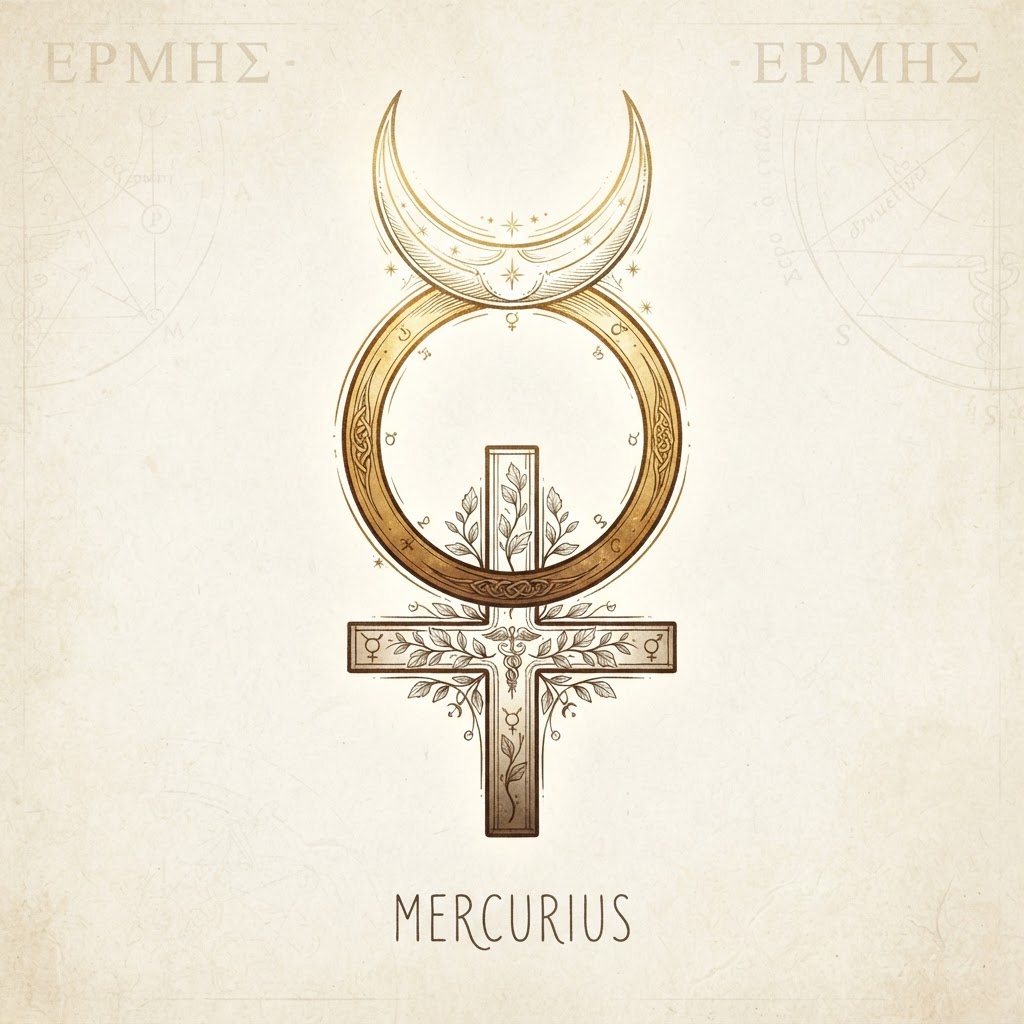
A crescent moon over a circle resting on a cross, representing the fluid, transformative spirit that links body and soul.
Quick Facts
- Category
- Hermetic
- Culture / Origin
- Hellenistic / European Hermeticism
- Geographic Origin
- Eastern Mediterranean, Europe
- Historical Period
- Classical Antiquity to Early Modern
- Estimated Age
- circa 300 CE
- Element
- Water
- Planet
- Mercury
- Chakra
- Throat, Third Eye
- Zodiac
- Gemini, Virgo
- Deities
- Hermes, Mercury, Thoth
- Verification
- unverified
What is Alchemical Mercury?
Alchemical Mercury is the fluid mediator of the Hermetic Tria Prima, standing between the fiery soul (Sulfur) and the dense physical body (Salt). Far from being just the toxic heavy metal quicksilver, philosophical Mercury is the vital life-spirit that animates all forms. Its symbol combines three geometric components: a crescent moon at the top, a solar circle at the middle, and an elemental cross at the bottom.
This glyph represents the total integration of lunar intuition, solar consciousness, and elemental matter. Mercury embodies fluidity, change, transformation, and communication across realms. In the Hermetic laboratory and within contemplative practice, Mercury acts as the universal solvent (alkahest), dissolving rigid structures so they can be recombined into higher, perfected states of being.
Meaning of Alchemical Mercury
Alchemical Mercury represents the dynamic, fluid universal spirit that facilitates transformation, connectivity, and spiritual change.
Origin & History
Mercury's chemical and mystical significance traces back to late Roman and Alexandrian Egypt, where its liquid metal qualities fascinated metallurgists and natural philosophers. Named after the fleet-footed messenger god Mercury (Hermes), it was considered anomalous because it was both metallic and fluid, defying standard elemental categorizations.
With Paracelsus and the formalization of the Tria Prima in the 16th century, Mercury was elevated to the foundational principle of volatility, moisture, and spiritual life force. It served as the central bridge in European alchemical literature, regarded as both the starting materia prima and the vehicle of final illumination in the opus magnum.
Spiritual Meaning
In the interior alchemy of the soul, Mercury is the spiritual consciousness itself—the bridge connecting the personal ego to transcendent divine light. Because it is inherently fluid, it can flow downward into base material attachments or ascend into ethereal realms of wisdom. It symbolizes the adaptable, non-judgmental awareness that must penetrate the dense mental blocks of the practitioner.
Working with philosophical Mercury means cultivating cognitive and psychological fluidity. The practitioner learns to dissolve dogmatic rigidity, transmute limiting emotional loops, and allow divine awareness to navigate easily between mundane daily reality and elevated contemplative heights.
Symbolism
The upper crescent moon signifies receptivity and the subconscious; the central solar circle denotes divine spirit and consciousness; the lower cross roots the cosmic energies into the four physical elements of Earth.
Traditional Uses
Represents the vital life-spirit (Spiritus) connecting body and soul, the feminine alchemical moisture, and the essential solvent required to dissolve base metals.
Modern Spiritual Uses
Associated in modern esoteric circles with psychological flexibility, energetic flow states, and the seamless integration of intuitive and rational mindsets.
Healing Associations
Used metaphorically to dissolve rigid psychological blockages, facilitate rapid energetic recovery, and restore fluid neural adaptability.
How the Symbol Is Used
- •Spiritual Alchemy
- •Spagyric Medicine
- •Meditation
- •Hermetic Philosophy
Cultural Context
Hellenistic / European Hermeticism — Eastern Mediterranean, Europe (Classical Antiquity to Early Modern)
Sources & References
- 1.The Hermetic and Alchemical Writings of Paracelsus edited by A.E. Waite
- 2.Mysterium Coniunctionis by C.G. Jung
- 3.Atalanta Fugiens by Michael Maier
This content is for educational and informational purposes only. Where modern spiritual interpretations are described, they are not presented as ancient historical facts. It is not a substitute for professional medical or spiritual advice.