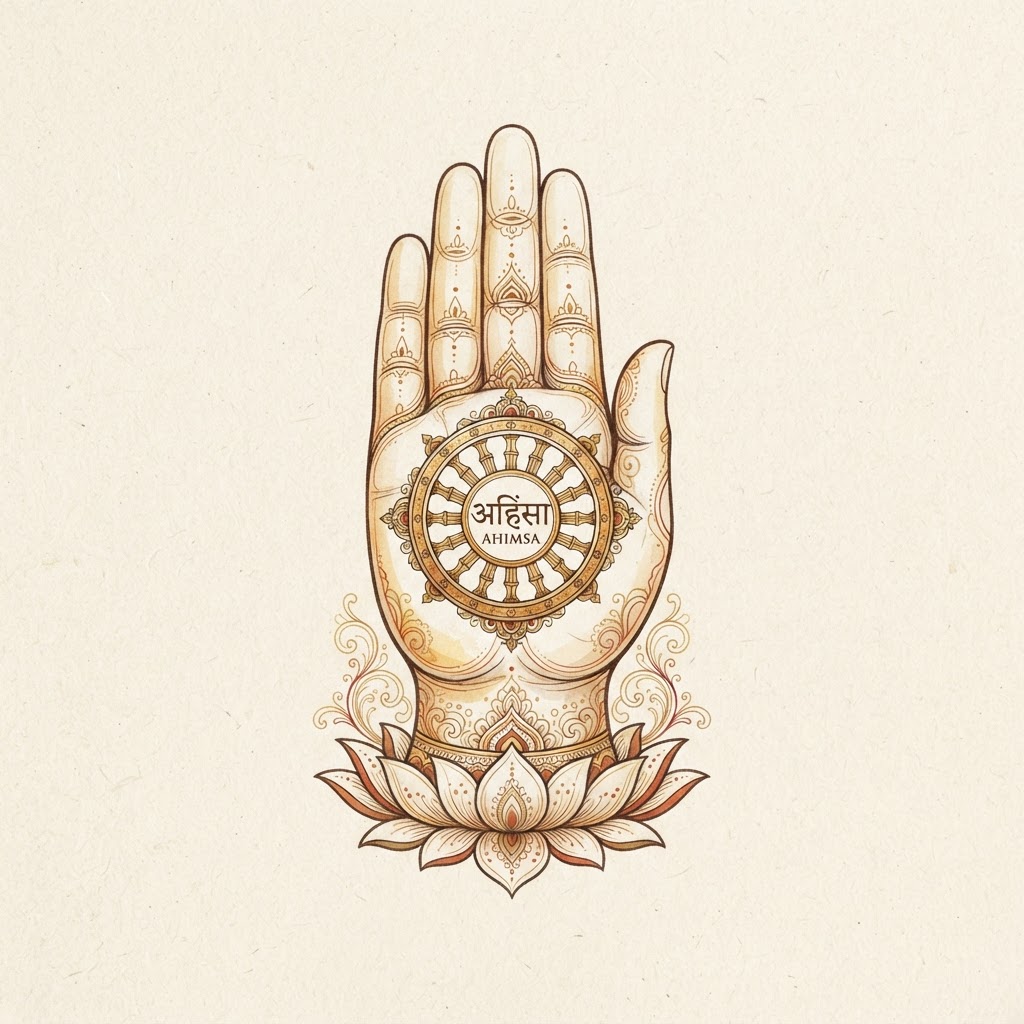
Ahimsa Hand: Meaning, Origin & Symbolism
Also known as: Abhayahasta with Dharmachakra, Ahimsa Hand Symbol
Jain
Jain
Heart Chakra
Air
Peace
Protection
Love
An open palm raised in fearlessness featuring a wheel with the word Ahimsa inscribed at its center.
Quick Facts
- Category
- Jain
- Culture / Origin
- Jain
- Geographic Origin
- India
- Historical Period
- Classical Antiquity
- Estimated Age
- circa 500 BCE
- Element
- Air
- Chakra
- Heart
- Deities
- Mahavira, Parshvanatha
- Verification
- unverified
What is Ahimsa Hand?
The Ahimsa Hand is one of the most recognizable emblems in Jainism, depicting an open right hand with an upturned palm facing outward. Inscribed within the palm is a 24-spoked wheel (Dharmachakra), which bears the Prakrit word 'Ahimsa' (non-violence) inscribed in its central hub.
The gesture itself mirrors the ancient Abhaya Mudra, the posture of fearlessness and protection. In the Jain ethos, fearlessness is reciprocal: one who does not harbor ill will or inflict violence upon any living entity ceases to experience existential fear.
The wheel set within the palm symbolizes the constant turning of the cycle of existence (Samsara) and the doctrine preached by the 24 Tirthankaras, which possesses the power to halt that perpetual rotation through unwavering ethical restraint.
Meaning of Ahimsa Hand
Absolute non-violence, compassionate restraint, and granting the gift of fearlessness to all living entities.
Origin & History
The gesture of the open palm conveying harmlessness has ancient roots across Indian ascetic traditions. In Jainism, it became formalized early on to represent the supreme vow (Mahavrata) of total non-injury toward all life, whether mobile or immobile.
Over centuries, it was carved onto stone tablets, votive slabs (Ayagapatas), and temple lintels, eventually becoming standardized in the modern official Jain emblem to immediately signify the essence of Jain ethical action.
Spiritual Meaning
The palm raised outward commands the spiritual seeker to stop, pause, and examine every thought, word, and physical action before causing harm to any being. It reminds the practitioner that real strength manifests as self-mastery and harmlessness.
By embodying the Ahimsa Hand, an individual creates an aura of sanctuary, reflecting the sacred truth that all souls share an identical desire to live and avoid suffering.
Symbolism
The open palm represents openness, non-aggression, and the bestowing of Abhaya (freedom from fear). The wheel within represents the wheel of Dharma preached by the 24 Tirthankaras, turning through worldly cycles to offer rescue.
Traditional Uses
Traditionally viewed as a reminder of the foundational ethical vow of Ahimsa, without which liberation cannot be attained, regardless of ascetic austerity.
Modern Spiritual Uses
Widely interpreted today as an emblem of animal rights, ecological stewardship, mindful living, and peaceful conflict resolution.
Healing Associations
Relieves inner hostility, calming anger and cultivating deep restorative empathy.
Protection Associations
Used as an emblem to dispel spiritual fear and protect sentient beings from violence.
How the Symbol Is Used
- •Ahimsa contemplation
- •Samayika
- •Daily prayers
Cultural Context
Jain — India (Classical Antiquity)
Sources & References
- 1.Tatia, Nathmal (trans.). That Which Is: Tattvartha Sutra. Yale University Press, 1994.
- 2.Long, Jeffery D. Jainism: An Introduction. I.B. Tauris, 2009.
This content is for educational and informational purposes only. Where modern spiritual interpretations are described, they are not presented as ancient historical facts. It is not a substitute for professional medical or spiritual advice.