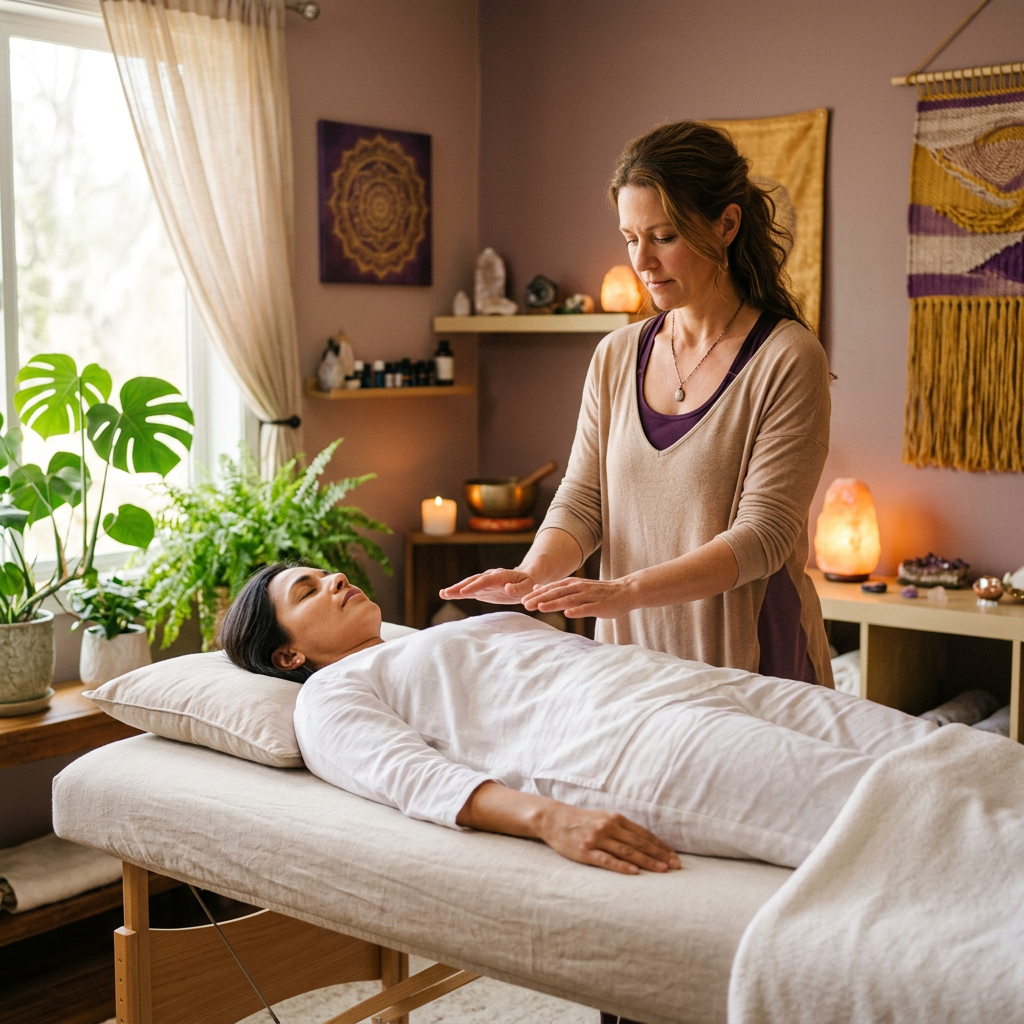
Reiki is one of the fastest-growing wellness practices in the English-speaking world — yet finding a practitioner who is genuinely qualified, ethical, and the right fit for you takes more than a Google search. This guide tells you everything you need to know before you book.
What is reiki?
Reiki (pronounced ray-kee) is a Japanese energy healing technique developed in the 1920s by Mikao Usui. The word combines rei (universal) and ki (life energy) — the same concept as chi in Chinese medicine and prana in Ayurvedic tradition. The practice works on the principle that disruptions in the body's energy field contribute to physical and emotional imbalance.
A reiki practitioner acts as a channel for this energy, placing their hands lightly on or just above the body to encourage the client's own healing response. You remain fully clothed throughout.
"Reiki is a simple, natural and safe method of spiritual healing and self-improvement that everyone can use." — Mikao Usui, founder of the Usui System of Reiki
What does the research say?
Reiki has been the subject of over 900 peer-reviewed studies. A 2019 systematic review published in the Journal of Integrative and Complementary Medicine found consistent evidence that reiki is more effective than placebo for reducing pain, anxiety, and fatigue. Many hospitals in the US and UK now offer reiki as part of integrative oncology programmes.
The US National Center for Complementary and Integrative Health (NCCIH) classifies reiki as a biofield therapy and notes that while more large-scale trials are needed, preliminary evidence is promising, particularly for pain, anxiety, and quality of life.
Reiki is not a substitute for medical care. Reiki works best as a complement to — not a replacement for — conventional medical treatment. A qualified practitioner will always encourage you to maintain your relationship with your GP or specialist. If any reiki practitioner advises you to stop prescribed medication or avoid medical treatment, leave immediately.
What to expect in a reiki session
If you've never had reiki before, here is exactly what happens — from arrival to aftercare:
Minutes 0–10 · Intake — Consultation & intention setting Your practitioner asks about your health, emotional state, and what you're hoping to experience. You'll discuss any physical areas of discomfort or emotional concerns. A good practitioner listens more than they talk at this stage.
Minutes 10–15 · Preparation — Getting settled on the table You lie face-up, fully clothed, on a padded massage table. The room is typically warm, softly lit, and quiet — often with gentle music. You're invited to close your eyes and breathe naturally. Remove shoes; leave everything else on.
Minutes 15–55 · Treatment — Hand positions across the body The practitioner works through a sequence of hand positions on or just above your head, neck, chest, abdomen, legs, and feet — spending 3–5 minutes at each position. You may feel warmth, tingling, heaviness, or simply deep relaxation. Some people experience emotional releases; some fall asleep.
Minutes 55–60 · Close — Grounding & integration The practitioner gently signals the session's end, gives you time to return to full alertness, and may share observations. You're offered water and a few minutes to sit quietly before leaving.
After the session · Aftercare Drink plenty of water, rest if possible, and avoid alcohol for 24 hours. Some people feel energised; others feel deeply tired — both are normal. A mild detox response (headache, emotional surfacing) can occasionally occur in the first 24–48 hours, particularly after initial sessions.
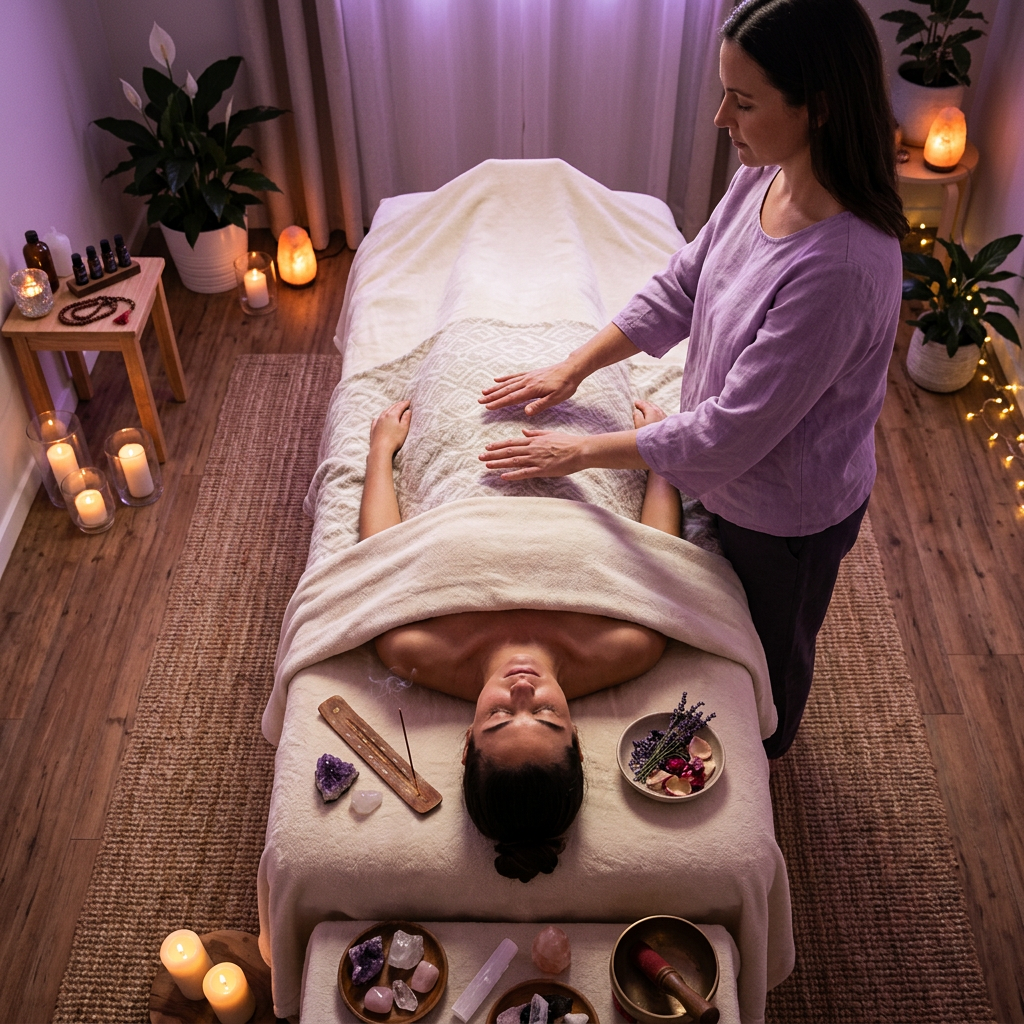
Reiki sessions last 45–90 minutes depending on your practitioner. Most people feel a noticeable shift after just one session.
The chakra system and what the practitioner is actually doing
Reiki works with the body's seven main energy centres, or chakras. Each is associated with specific physical organs, emotional states, and life areas:
- Root — Security, grounding, adrenal system
- Sacral — Creativity, emotional regulation, reproductive health
- Solar Plexus — Confidence, digestion, personal boundaries
- Heart — Emotional healing, grief, self-love, immune system
- Throat — Communication, self-expression, thyroid support
- Third Eye — Intuition, focus, sleep quality
- Crown — Clarity, spiritual connection, nervous system
During a session, the practitioner intuitively senses where energy feels blocked or depleted and spends more time in those areas. The most common hand positions cover the crown of the head, eyes and temples, throat, heart centre, solar plexus, sacral/lower abdomen, hips/thighs (root), and feet.
Reiki levels explained — and why they matter
Reiki training is structured in three levels (or degrees), with an additional Master/Teacher tier:
| Level | Also called | What it covers | Can treat clients? |
|---|---|---|---|
| Level I | Shoden / First Degree | In-person self-healing and basic hand positions. Typically a 1–2 day course. | Self only |
| Level II | Okuden / Second Degree | Sacred symbols, distance healing, and working with others professionally. | Yes — suitable for client practice |
| Level III | Shinpiden / Master | Advanced energy work, master symbol, deeper personal practice. | Yes — advanced client work |
| Master/Teacher | Reiki Master Teacher | All of the above, plus the ability to attune and train new students. | Yes — can also train others |
⚠️ Important: A practitioner offering paid sessions should hold at minimum a Reiki Level II certificate from a qualified teacher. Be cautious of anyone advertising themselves as a professional reiki healer whose training lasted only a weekend at Level I. Always ask — and a good practitioner will be happy to tell you.
Usui Reiki vs other lineages
The most common form is Usui Reiki (the original Mikao Usui system). You may also encounter Karuna Reiki, Holy Fire Reiki, and Rainbow Reiki — these are later evolutions and offshoots. All valid; just be aware that some lineages are more established than others.
How to find a reiki practitioner near you
1. Search a verified practitioner directory
The quickest and safest route. The MyHealer reiki directory lists verified practitioners across Australia, the US, and the UK — all with confirmed training credentials. Filter by suburb or city, in-person vs remote, price range, and gender preference.
2. Check international reiki associations
- Australia: Reiki Australia — maintains a national register of practitioners
- UK: The UK Reiki Federation and CNHC (voluntary register)
- US: International Center for Reiki Training (ICRT) and International Association of Reiki Professionals (IARP)
3. Ask at your local holistic centre or spiritual shop
Many spiritual shops and wellness centres host resident reiki practitioners or can refer you to someone they personally know. This is often how the most trusted local names circulate — through community recommendation rather than online advertising.
4. Request a referral from a naturopath or integrative GP
If you're already working with a naturopath or integrative doctor, ask who they refer clients to for reiki. Practitioners who receive professional referrals tend to be held to higher standards.
5. Attend a reiki share or community event
Many reiki practitioners run free or low-cost "reiki shares" — group sessions where you can experience the practice and meet practitioners before committing to a private booking. Search "reiki share [your city]" or check local Facebook groups and Meetup.com.
Green flags and red flags
✅ Green flags — book with confidence:
- Holds Reiki Level II or above from a named teacher
- Member of a national reiki association (Reiki Australia, UK Reiki Federation, IARP)
- Carries professional indemnity insurance
- Conducts a health intake before first session
- Sets clear expectations about what reiki can and cannot do
- Respects physical boundaries — asks consent before any touch
- Offers a free 15-min discovery call
- Has genuine, detailed client reviews (not just stars)
- Willing to collaborate with your GP or other practitioners
🚩 Red flags — proceed with caution or walk away:
- Can't name their reiki teacher or training institution
- Trained at Level I only but takes paying clients
- Promises to "cure" specific conditions or diseases
- Pressures you to buy supplements, crystals, or expensive packages upfront
- Discourages you from seeing a doctor or taking medication
- No intake conversation — starts immediately without context
- Creates a sense of emotional dependency between sessions
- Can't provide proof of insurance when asked
8 questions to ask before you book
- What level of reiki are you attuned to, and who was your teacher? — You want at minimum Level II, from a named Master Teacher.
- Are you a member of Reiki Australia / the UK Reiki Federation / IARP? — Membership confirms ongoing accountability and professional standards.
- Do you carry professional indemnity and public liability insurance? — This protects you if anything goes wrong.
- Do you conduct a health intake before the first session? — They should ask about medications, recent surgery, pregnancy, or any conditions that affect how they work with you.
- Will you use hands-on touch, hands-off, or a combination? — Both are valid. Know what to expect so you can set appropriate boundaries.
- How many sessions do you typically recommend for someone with my situation? — Look for a realistic, time-bound estimate — not an open-ended commitment.
- Do you offer distance reiki sessions? — Level II and above practitioners can offer remote sessions, which work surprisingly well for many people.
- What's your cancellation and refund policy? — Should be written and provided before your first session.
Reiki session costs in Australia, the UK and the US
| Session type | Australia (AUD) | UK (GBP) | US (USD) | Length |
|---|---|---|---|---|
| Standard 60-min session | $80–$140 | £45–£85 | $65–$130 | 60 min |
| Initial/first session | $120–$180 | £65–£100 | $90–$160 | 60–90 min |
| Package of 5 sessions | $380–$550 | £200–£380 | $280–$550 | — |
| Distance session | $70–$120 | £40–£70 | $60–$100 | 45–60 min |
| Mini session | $50–$80 | £30–£50 | $40–$70 | 30 min |
| Extended session | $120–$200 | £70–£120 | $90–$180 | 90 min |
💡 Is reiki covered by health insurance?
- Australia: Reiki is not typically covered by standard private health extras. Some funds cover related modalities — check your specific policy.
- UK: Not covered by NHS. Some private health insurers (AXA Health, Vitality) may cover complementary therapies as part of a wellbeing benefit.
- US: Generally not covered by insurance. Some HSA/FSA plans now permit holistic therapies — check with your plan administrator.
Who benefits most from reiki?
Reiki is safe for almost everyone, but research and practitioner experience consistently show the strongest results in these areas:
- Stress & anxiety — Significant reductions in anxiety scores, particularly pre-surgery and in oncology settings (strong evidence)
- Chronic pain — Reductions in pain intensity across multiple conditions; strongest for cancer-related pain (moderate evidence)
- Fatigue — Improved energy levels in cancer patients undergoing chemotherapy (moderate evidence)
- Depression — Reductions in depressive symptoms; works well alongside conventional therapy (moderate evidence)
- Sleep quality — Improvements in sleep quality and duration, particularly in older adults (emerging evidence)
- Menopause symptoms — Early evidence for reduction in hot flushes, mood disturbances, and sleep disruption (emerging)
Who should check with a doctor before beginning reiki?
- People with pacemakers
- Those in the first trimester of pregnancy
- Anyone undergoing active cancer treatment (reiki is generally safe, but inform your oncologist)
- People with severe psychiatric conditions — should be used alongside, not instead of, psychiatric care